How Should CIOs Decide What to Cut to Pay for AI?
Key Highlights
- There’s a difference between what companies are cutting to fund AI and what CIOs should cut.
- CIOs should target waste, redundant tools, unused licenses and underperforming AI before cutting technology AI depends on.
- AI investments should compete for capital based on business value, with costs shared by the functions benefiting from them.

AI has become one of those expenses that everyone wants until somebody has to figure out where the money comes from.
More and more, that somebody is the CIO.
And when AI runs over budget, companies aren't necessarily stopping the AI. Almost half of organizations said AI spending was moderately or substantially over budget in 2026, according to an August research survey from market research firm Enterprise Technology Research (ETR).
Among those reallocating existing IT money to fund AI, 61% cut external contractors and consultants, 49% pulled from legacy infrastructure modernization and hardware refreshes, and 36% reduced non-AI software licenses.
Meanwhile, only 17% of organizations that exceeded their AI budgets paused or scaled back the AI initiative, and 48% pursued additional budget approval.
That says something about AI's position in the technology portfolio: When AI costs more than expected, companies are more likely to find money somewhere else than stop spending it on AI.
That's where CIOs need to be careful. What some companies are cutting and what they should cut aren't necessarily the same thing.
CIOs should first look for waste, redundant software and underperforming AI initiatives before cutting cybersecurity, infrastructure modernization or other technology that supports AI. The goal is to free up funding without undermining the investments needed to deliver business value.
How are companies reallocating IT budgets to fund AI?
Some of the money is simply coming from bigger budgets. Three-quarters of CFOs planned to increase tech budgets in 2026, and 48% expected increases of at least 10%, according to a February Gartner CFO survey.
But bigger budgets don't eliminate tradeoffs.
McKinsey & Company found that AI, especially agentic AI, is consuming as much as one-third of some companies' technology "change" budgets. Its March analysis, “Recalibrating Technology Budgets for the AI Era,” argues that companies can't simply spend more. They need to spend differently, including replacing legacy systems instead of layering new technology on top.
If AI gets another dollar, CIOs need to know what deserves one less.
Where should CIOs look for AI savings first?
CIOs looking to fund AI initiatives should first review cloud spending, SaaS subscriptions, software licenses and consulting expenses for opportunities to eliminate waste.
The State of FinOps 2026 Report says many organizations are being told to self-fund AI through optimization savings. Workload optimization and waste reduction remain the top FinOps priority, while AI has become the top forward-looking priority.
That's a fairly straightforward funding strategy: Find money already being wasted before cutting something the business still needs.
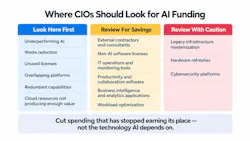
And AI overruns are already accelerating that cleanup. Among enterprises cutting non-AI software to pay for AI, ETR found that common targets included IT operations and monitoring tools, productivity and collaboration software, and business intelligence and analytics applications.
That doesn't mean CIOs need to indiscriminately cut those categories. Look instead for overlapping platforms, unused licenses, redundant capabilities and cloud resources that aren't producing enough value.
Consulting deserves similar scrutiny. As AI becomes a core capability, CIOs should determine which outside expertise remains necessary and which skills make more sense to build internally.
Protect cybersecurity and infrastructure investments that support AI
Some sources of funding carry considerably more risk.
For example, professional services firm RSM's July Middle Market AI Survey found companies expecting higher AI spending were most likely to reduce business intelligence or analytics initiatives, cited by 43% of respondents; cybersecurity investments, 41%; and external consulting and advisory services, 40%.
Cybersecurity spending should still face scrutiny. A redundant platform isn't automatically worth protecting. But cutting security controls needed to secure AI's additional identities, data access and autonomous actions can create more chaos and costs than the savings used to fund AI.
Other research suggests security may be more protected. Only 18% of organizations reallocating software spending for AI pulled money from cybersecurity, according to ETR’s Summer 2026 Macro Views Survey.
The same caution applies to modernization.
Canceling a low-value modernization project because its business case no longer holds is portfolio management. But delaying upgrades to databases, integration layers or aging platforms that AI depends on can undermine the very AI investments CIOs are trying to fund.
CIOs should distinguish legacy spending that preserves technical debt from modernization that removes it before taking money from either. (See our TechEDGE article, “How IT Leaders Can Manage Technical Debt Without Modernizing Everything.”)
Cloud, SaaS, licensing and consulting offer obvious places to look for opportunities to cut waste.
Cut low-value AI projects to fund higher-value ones
There's another place CIOs should look for AI funding: underperforming AI investments.
Only 13% of CIOs say their enterprises have realized significant or transformational value from AI, according to an October 2026 Gartner survey. At the same time, 51% expect AI to increase the total cost of ownership of tech solutions.
A pilot program shouldn't earn permanent funding just because it contains AI. IT leaders should be willing to stop experiments without a business owner, measurable outcome or credible path to production.
So, survivors get more money. The rest stop consuming it.
How should CIOs decide which AI investments to fund?
Deloitte's October analysis of its Finance Trends 2027 study recommends managing AI as an investment portfolio, with expected returns, understood risks and measurable business outcomes.
That means AI should compete with other technology investments for funding — and business units should share the bill when they're expecting the benefit.
Corporate AI spending had doubled to 3.3% of revenue, with more than 80% of AI spending sitting outside the enterprise IT budget, according to consulting firm BCG's September Applied AI Index findings. That could be a healthy shift. If AI is supporting sales, manufacturing, finance or customer service, those business units should have some skin in the game.
CIOs don't need to protect every dollar already in the tech budget. Some spending should disappear. But AI shouldn't automatically jump the line just because it's AI.
Key takeaway: Cut spending that has stopped earning its place. Make AI compete for capital. And don't weaken the technology AI needs just to pay this year's AI bill.
About the Author
 Theresa Houck
Contributor
Theresa Houck is an award-winning B2B journalist with more than 35 years of experience covering industrial markets, strategy, policy, and economic trends. As Senior Editor at EndeavorB2B, she writes about IT, OT, AI, manufacturing, industrial automation, cybersecurity, energy, data centers, healthcare, and more. In her previous role, she served for 20 years as Executive Editor of The Journal From Rockwell Automation magazine, leading editorial strategy, content development, and multimedia production including videos, webinars, eBooks, newsletters, and the award-winning podcast “Automation Chat.” She also collaborated with teams on social media strategy, sales initiatives, and new product development.
Before joining EndeavorB2B, she was an Industry Analyst at Wolters Kluwer in its human resources book publishing operation. Before that, she spent 14 years with the Fabricators & Manufacturers Association, Intl., serving as Executive Editor of four magazines in the sheet metal forming and fabricating sector, where she managed and executed editorial strategy, budgets, marketing, book publishing, and circulation operations, and negotiated vendor contracts.
Houck holds a Master of Arts in Communications from the University of Illinois Springfield and a Bachelor of Arts in English from Western Illinois University.
 Resources
Quiz
Related
 Four stacks of coins showing a rising curve, on top of paper symbolizing rising costs.

 Business man and woman collaborating using financial documents and iPad. Your Competitive Edge, Delivered
Stay ahead of the curve with weekly insights into emerging technologies, cybersecurity, and digital transformation. TechEDGE brings you expert perspectives, real-world applications, and the innovations driving tomorrow’s breakthroughs, so you’re always equipped to lead the next wave of change.