How IT Leaders Can Manage Technical Debt Without Modernizing Everything
Key Highlights
- Technical debt is bigger than an IT maintenance issue; it can raise costs, slow innovation and limit the business’s ability to move forward.
- Don’t modernize based on system age alone. Focus first on what creates the greatest business risk, cost or strategic constraint.
- Not all technical debt needs fixing. The key is knowing what to reduce, what to tolerate and what the business can safely carry.
- AI can speed up modernization work, but it can’t decide what to modernize. Business value and risk still need to drive those calls.

Prefer to Listen?
If you’ve ever carried debt, you know how interest works: The longer it goes unpaid, the more expensive it becomes. Technical debt works much the same way.
Technical debt accumulates when teams prioritize short-term speed over long-term maintainability. Gartner’s technical debt research describes it as “borrowing” against long-term quality through sacrifices, shortcuts and workarounds that can eventually make systems harder to maintain and change while affecting performance, scalability and resilience.
Legacy systems can compound the problem, but age alone isn’t technical debt. An older system that reliably supports the business may pose less risk than a newer application riddled with dependencies, security gaps or costly workarounds.
The goal isn’t to eliminate every source of technical debt, but to understand where that debt is limiting the business and decide what you can afford to carry, what it needs to reduce and what it can no longer ignore.
Build visibility before making modernization decisions
Before deciding what to modernize, you need to know what you have, what it costs and what depends on it.
That sounds straightforward. But in many organizations, it isn’t.
Enterprises may still rely on outdated Configuration Management Databases (CMDBs), institutional knowledge that hasn’t been documented, and cloud environments that have expanded faster than governance. The result can be an incomplete picture of technology assets, hidden dependencies and continued spending on systems that no longer support business priorities.
Not all technical debt needs immediate resolution, but all technical debt must be visible to leadership.
Lack of visibility makes technical debt harder to identify, quantify and prioritize. It also makes modernization riskier.
Deloitte’s modernization research notes that fragmented data and growing technology complexity can undermine the ROI of transformation efforts, while legacy technical debt can make it harder for you to quickly take advantage of emerging technologies such as generative AI.
So, start by taking a decision-grade inventory that identifies:
- Business-critical applications.
- Infrastructure and cloud platforms.
- Key integrations and dependencies.
- Data platforms and pipelines.
- Duplicate systems.
- End-of-life technologies.
Rather than simply creating a more accurate asset list, the goal is to understand how technology supports or limits the business. That visibility can expose hidden costs, redundant platforms and dependencies that should influence where modernization dollars go.
Prioritize by business impact, not system age
One of the easiest modernization mistakes to make is assuming the oldest systems should go first. But age alone doesn’t determine risk. Business dependency does.
For example, a 15-year-old payroll system that performs reliably may pose less immediate risk than a newer application that repeatedly disrupts customer operations or prevents the company from pursuing a strategic initiative.
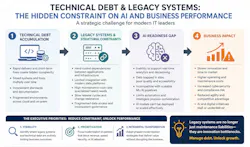
And technical debt is a business and financial constraint (see Table 1). McKinsey & Company’s 2025 analysis of enterprise technology economics says companies pay an additional 10% to 20% on top of project costs to address technical debt, creating a drag on productivity.
That’s why technical debt should be evaluated in business terms. Factors to consider include:
- Revenue dependency.
- Operational risk.
- Security exposure.
- Customer impact.
- Maintenance cost.
- Ability to support strategic initiatives such as AI.
Legacy systems and accumulated technical debt can create structural constraints that raise costs and slow innovation. McKinsey & Company describes technical debt as a “vicious development cycle that increases costs and slows innovation.”
Technical debt may also make it harder to use the data and infrastructure required for AI and advanced analytics.
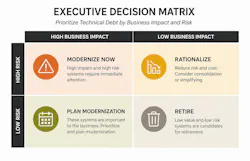
An executive decision matrix (see Table 2) can help turn those findings into action:
- High impact + high risk: Modernize immediately.
- High impact + low risk: Plan modernization.
- Low impact + high cost: Rationalize.
- Low value: Retire.
The goal is to move the discussion beyond which technology is oldest or most frustrating to maintain. The more useful question is what the business should do with each source of debt: fund its reduction, tolerate it for now, contain its impact or retire the underlying system.
Modernize strategically: Not everything needs replacing
Once priorities are clear, the next decision is what to do about them. Modernization doesn’t automatically mean replacing a system.
Different applications call for different approaches:
- Retire systems that no longer provide enough value to justify their cost.
- Replatform workloads that can benefit from modern infrastructure without extensive changes to the application itself.
- Refactor valuable applications when targeted improvements can extend their useful life.
- Replace systems when their limitations, risks or costs outweigh the value of continued investment.
The right choice depends on business value, risk, cost and strategic importance. That’s why modernization is better managed as an ongoing portfolio strategy than as a one-time cleanup project.
Some technical debt may need immediate attention. Some can be reduced gradually. And some may be perfectly reasonable to carry if the cost and risk of fixing it outweigh the business benefit.
Governance controls how much new debt you take on
Paying down existing technical debt solves only half the problem. Without governance, new technology debt can accumulate as quickly as old debt is removed.
That doesn’t mean you should try to prevent all technical debt. Short-term tech tradeoffs are sometimes necessary to meet a deadline, launch a product or respond to changing business conditions. The problem comes when those decisions are made without clear ownership or a plan for what happens next.
Effective governance can include:
- Architecture standards.
- Application life cycle policies.
- Clear ownership of major systems.
- Executive reporting on technology health.
- Budget alignment between innovation and maintenance.
A best practice is for executives to regularly ask:
✓ Are modernization priorities aligned with business strategy?
✓ Does every major system have clear ownership?
✓ Are lifecycle policies being enforced?
✓ Is material technical debt visible in executive reporting?
✓ Are we controlling new debt while reducing the debt that creates the greatest business risk?
This turns technical debt from an occasional IT cleanup exercise into a managed business tradeoff.
AI can accelerate modernization, but it can’t set the priorities
AI is changing some of the economics of modernization by reducing the time and effort required to understand complex technology environments. In fact, Deloitte’s 2025 analysis of legacy modernization with AI specifically discusses using generative AI, agents and reasoning models to help remove technical debt and reengineer the digital core.
Teams can use AI to:
- Analyze legacy code.
- Map application dependencies.
- Support migration planning.
- Automate portions of code refactoring and testing.
These capabilities can help teams assess complex environments faster and reduce some of the manual work involved in modernization. That may turn projects into practical activities that previously seemed too costly or time-consuming.
5 Questions Every CIO Should Ask About Technical Debt
- Which systems directly support revenue?
- Which create security or compliance risk?
- Which systems delay digital initiatives?
- Which cost more than the value they deliver?
- Which systems limit AI adoption?
But AI doesn’t answer the most important question: What should the enterprise modernize in the first place?
That decision still requires an understanding of business value, risk, cost and strategic priorities. AI can help teams understand and address technical debt faster, but it can’t decide which debt the business can afford to carry.
Technical debt is a tradeoff to manage
Technical debt isn’t something an enterprise eliminates once and moves on from. Nor should eliminating every source of debt be the goal.
The real decisions are how much debt you’re willing to accept, where it can safely tolerate that debt and when the cost of carrying it has become greater than the cost of addressing it.
With visibility into the technology environment, priorities tied to business impact and governance that keeps new debt in check, you can make those decisions deliberately, instead of waiting for the interest to come due.
About the Author
 Theresa Houck
 Theresa Houck
Contributor
Theresa Houck is an award-winning B2B journalist with more than 35 years of experience covering industrial markets, strategy, policy, and economic trends. As Senior Editor at EndeavorB2B, she writes about IT, OT, AI, manufacturing, industrial automation, cybersecurity, energy, data centers, healthcare, and more. In her previous role, she served for 20 years as Executive Editor of The Journal From Rockwell Automation magazine, leading editorial strategy, content development, and multimedia production including videos, webinars, eBooks, newsletters, and the award-winning podcast “Automation Chat.” She also collaborated with teams on social media strategy, sales initiatives, and new product development.
Before joining EndeavorB2B, she was an Industry Analyst at Wolters Kluwer in its human resources book publishing operation. Before that, she spent 14 years with the Fabricators & Manufacturers Association, Intl., serving as Executive Editor of four magazines in the sheet metal forming and fabricating sector, where she managed and executed editorial strategy, budgets, marketing, book publishing, and circulation operations, and negotiated vendor contracts.
Houck holds a Master of Arts in Communications from the University of Illinois Springfield and a Bachelor of Arts in English from Western Illinois University.
 Resources
Quiz
Your Competitive Edge, DeliveredStay ahead of the curve with weekly insights into emerging technologies, cybersecurity, and digital transformation. TechEDGE brings you expert perspectives, real-world applications, and the innovations driving tomorrow’s breakthroughs, so you’re always equipped to lead the next wave of change.