How Can CIOs Keep AI Inference Costs From Spiraling?
Key Highlights
- Successful AI adoption can create unsustainable costs unless IT leaders connect spending directly to business value.
- Cost per business outcome matters more than cost per token, request or model call.
- Managing AI demand is often more effective than simply reducing infrastructure expenses.
- Clear ownership, governance thresholds and regular reviews are essential for controlling inference economics.

Prefer to Listen?
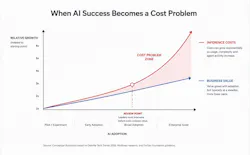
The more successful an AI application becomes, the more expensive it can become to run.
Training a model may be costly, but it’s mostly a one-time investment. Inference — the process of generating responses once a model is in production — is different. Every employee query, customer interaction and automated workflow adds to the bill. As adoption grows, costs can rise far faster than many enterprises expect.
That makes inference a leadership issue, not simply an infrastructure problem.
Deloitte’s Tech Trends 2026 report found that although token costs have fallen dramatically, some enterprises are still seeing monthly AI bills reach tens of millions of dollars because usage is growing even faster.
Meanwhile, McKinsey & Company’s research, “Reimagining tech infrastructure for (and with) agentic AI,” projects IT infrastructure costs could increase two to three times by 2030 as AI workloads expand, even as budgets remain relatively flat.
For CIOs, CTOs, CISOs and other technology leaders, the core question is no longer, "How do we scale inference reliably?" It is: "How do we prevent successful AI adoption from creating an unsustainable cost structure?"
The answer has less to do with GPUs and model benchmarks than with governance, accountability and economics.
10 questions to ask before scaling an AI workload
Before approving large-scale AI deployments, executive teams should be able to answer:
- What business outcome does this workload support?
- What is the acceptable cost per business outcome?
- How much usage should we expect if adoption succeeds?
- Does every request require a model call?
- Does every task require the most capable model?
- Is premium latency justified by the use case?
- Which business unit owns the workload?
- Who approves higher consumption levels?
- What happens if costs grow faster than value?
- What triggers a reassessment of the workload?
These questions form the foundation of AI inference economics.
The challenge isn't simply scaling AI, but scaling AI sustainably. The following four leadership questions can help determine whether growing AI consumption is creating business value or just a bigger bill.
1. Is the workload valuable enough to scale?
One of the fastest ways to overspend on AI is to assume every workload deserves the same model, service level and investment.
It doesn't.
An AI application supporting revenue-generating customer interactions may justify premium performance and higher costs. An internal summarization assistant might not.
Before scaling any workload, leaders should require teams to define its business value and expected economics. The goal is to maximize business outcomes rather than model performance.
McKinsey & Company’s analysis, “Cost versus value: Managing agentic AI system performance,” makes a similar point: Organizations often focus first on models and technical optimization instead of defining the business KPIs that determine whether an AI system creates enough value to justify its cost.
The most important metric isn’t cost per token or cost per request. It’s cost per business outcome.
The most important metric isn’t cost per token or cost per request. It’s cost per business outcome.
Executive teams should understand:
- The business objective the workload supports.
- Expected adoption levels.
- Required service levels.
- Acceptable cost per outcome.
- How economics change if usage grows tenfold.
That last question matters. A pilot that looks inexpensive at 10,000 requests can become a very different investment at 10 million.
2. How much AI does the process actually need?
Many discussions about inference efficiency focus on reducing the cost of compute.
The bigger question may be whether all that compute is necessary in the first place.
As enterprises deploy agentic systems capable of making multiple model calls to complete a single task,
AI consumption can grow rapidly. McKinsey’s 2026 research on managing AI demand at scale found that AI spending often accelerates as organizations move from experimentation to enterprise-wide adoption, while many still lack effective controls over consumption.
Technology leaders should challenge assumptions such as:
- Does every request require an AI model call?
- Does every task require the most capable model?
- Are agentic workflows creating unnecessary inference activity?
- Is premium latency creating measurable business value?
How much inference does this business process actually need? That question should become a standard governance review item.
Enterprises that manage demand effectively often achieve better economics than those focused exclusively on lowering infrastructure costs. The objective isn’t simply serving requests more cheaply. It is avoiding unnecessary requests altogether.
3. Measure the cost of the outcome, not the model call
The most capable model isn’t always the right model.
The cheapest model isn’t always the right model, either.
McKinsey & Company’s 2025 Technology Trends Outlook notes that falling inference costs and increased competition among proprietary and open models are giving enterprises more choices in how they align models with workloads.
Warning Signs Your AI Costs Are About to Spiral
Watch for these indicators that AI adoption is becoming a cost problem.
✓ AI usage is growing faster than business KPIs.
✓ Multiple business units are consuming AI services without cost ownership.
✓ Teams automatically default to the most capable model.
✓ Agentic workflows are generating large numbers of model calls with little visibility.
✓ AI spending is tracked centrally, but value measurement remains decentralized.
✓ Production workloads are running in the same environment chosen during a pilot.
✓ No predefined thresholds trigger architecture or economic reviews.
If three or more of these are true, it may be time to reassess the workload's economics.
A practical approach is to match model capability to business requirements. Routine tasks can often be handled by smaller, less expensive models, while complex, regulated or higher-risk use cases may justify more advanced models.
The key is evaluating total business cost rather than model pricing in isolation.
A lower-cost model that requires repeated attempts, manual validation or escalation may end up costing more than a higher-priced alternative that completes the task correctly the first time.
The leadership decision isn’t which single model the enterprise should standardize on.
It’s whether the enterprise can consistently choose the model that delivers the required business outcome at the most sustainable cost.
4. Assign ownership for AI spending
One of the biggest risks in AI adoption is that nobody owns the economics.
Executives can’t manage inference costs if they can’t identify who consumes resources, who benefits from that consumption and who is accountable when spending rises faster than value.
Flexera’s 2026 AI research found that organizations reported significantly less visibility into AI software spending than in more mature areas of technology management.
Visibility is necessary, but it’s not enough. CIOs also need clear decision rights. For every significant AI workload, organizations should know:
- Which business unit owns it.
- Who approves increased consumption.
- Who can pause, redesign or retire it.
- What happens when costs grow faster than expected value.
- Which KPIs determine success.
The FinOps Foundation’s 2026 guidance, “Token Economics: Managing AI Value in SaaS Model Token Costs,” recommends establishing visibility into providers and usage before moving toward more advanced cost-allocation approaches such as showback and chargeback.
Executive AI spending checklist
At minimum, executive dashboards should track:
✓ Cost by application.
✓ Cost by business unit.
✓ Usage growth trends.
✓ Cost per business outcome.
✓ Model consumption.
✓ Infrastructure consumption.
✓ Business KPI performance.
The goal isn’t better dashboards; it's accountability.
A brief note on infrastructure decisions
Infrastructure still matters, but it should support economic decisions rather than drive them.
Deloitte’s 2026 AI infrastructure research describes an emerging hybrid model in which cloud environments support variable demand, while private or dedicated infrastructure may become more economical for predictable, high-volume workloads.
For CIOs, CTOs, CISOs and other tech leaders should ask, “How do we prevent successful AI adoption from creating an unsustainable cost structure?”
Workload placement should follow usage patterns, business requirements, security needs and regulatory obligations. Just as importantly, enterprises should periodically revisit those decisions as adoption changes rather than allowing an environment chosen during experimentation to become permanent by default.
Set thresholds for reassessing the investment
Inference economics aren’t solved with a one-time architecture review. Models improve. Prices change. Usage grows. Experimental applications become business-critical systems.
Instead of relying on intermittent reviews, enterprises should establish governance thresholds that automatically trigger reassessment.
Those triggers might include:
- Costs exceeding an agreed threshold.
- Adoption growing materially faster than forecast.
- Failure to meet business KPIs.
- The availability of a materially cheaper or more capable model.
- A workload transitioning from experimental to business critical.
The FinOps Foundation notes that AI economics can shift quickly as models, architectures and usage patterns evolve, making previously rational decisions less effective over time.
The question leaders should ask isn’t whether a workload was well optimized six months ago. It's whether it still makes economic sense today.
The CIO's role in AI inference economics
AI inference costs will not be controlled by a single model choice, a cloud contract or an architecture decision.
They will be controlled by whether leaders can connect AI consumption to business value, assign ownership for spending and intervene before growth becomes unaffordable.
Organizations that succeed with AI at scale will treat inference economics as an ongoing governance discipline, not a technical tuning exercise.
Ultimately, the most important inference question isn’t how efficiently a workload runs, but whether the business can continue to afford its success.
About the Author
 Theresa Houck
 Theresa Houck
Contributor
Theresa Houck is an award-winning B2B journalist with more than 35 years of experience covering industrial markets, strategy, policy, and economic trends. As Senior Editor at EndeavorB2B, she writes about IT, OT, AI, manufacturing, industrial automation, cybersecurity, energy, data centers, healthcare, and more. In her previous role, she served for 20 years as Executive Editor of The Journal From Rockwell Automation magazine, leading editorial strategy, content development, and multimedia production including videos, webinars, eBooks, newsletters, and the award-winning podcast “Automation Chat.” She also collaborated with teams on social media strategy, sales initiatives, and new product development.
Before joining EndeavorB2B, she was an Industry Analyst at Wolters Kluwer in its human resources book publishing operation. Before that, she spent 14 years with the Fabricators & Manufacturers Association, Intl., serving as Executive Editor of four magazines in the sheet metal forming and fabricating sector, where she managed and executed editorial strategy, budgets, marketing, book publishing, and circulation operations, and negotiated vendor contracts.
Houck holds a Master of Arts in Communications from the University of Illinois Springfield and a Bachelor of Arts in English from Western Illinois University.
 Resources
Quiz
Your Competitive Edge, DeliveredStay ahead of the curve with weekly insights into emerging technologies, cybersecurity, and digital transformation. TechEDGE brings you expert perspectives, real-world applications, and the innovations driving tomorrow’s breakthroughs, so you’re always equipped to lead the next wave of change.