The New FinOps: Managing AI Portfolios, Not Just Costs
Key Highlights
- Traditional FinOps models struggle with AI because spending is less predictable and harder to connect directly to business value.
- FinOps is evolving from cost control into a portfolio-management discipline for AI investments, resource, and talent.
- GPUs are becoming strategic assets, forcing leaders to make deliberate allocation decisions across competing AI initiatives.

Many CIOs can tell you how much they're spending on AI. But few can confidently identify which AI initiatives deserve more funding, which should be scaled across the organization, and which should be shut down.
And that reveals a growing weakness in traditional FinOps models.
Traditional FinOps was built for a world of fairly predictable cloud spending. AI introduces spending patterns that are more volatile, harder to forecast and more difficult to connect to business outcomes.
AI introduces cost structures many FinOps programs were never designed to manage. And according to the FinOps Foundation, AI introduces new consumption metrics, GPU-related costs and rapidly changing spending models that require different management approaches.
As AI investments grow, FinOps is moving beyond cloud cost management and becoming a framework for AI investment governance, helping IT leaders decide where to allocate budget, compute resources and talent to produce the greatest business impact.
Let's examine why traditional FinOps models are changing in the AI era and what that means for IT leaders.
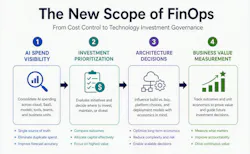
The real shift: FinOps is becoming portfolio management
Traditional FinOps focused on controlling costs, but AI requires company executives and IT leaders to answer a more difficult question: Which initiatives deserve additional investment?
Although most organizations have approval processes for new technology projects, many don’t have structured mechanisms for deciding which AI pilots should scale, which warrant additional funding and which should be retired.
That's becoming a serious management problem. Without disciplined review processes, leaders risk keeping resources tied to projects generating limited business value, while higher-potential opportunities compete for funding, talent and GPU capacity.
Here’s the shift that AI is causing: Traditional FinOps asks whether costs are being controlled, while AI-era FinOps asks where capital, GPUs and skilled personnel should be deployed to create the greatest business value.
For IT leaders, that means treating AI initiatives as an investment portfolio rather than a collection of technology projects. Funding reviews should focus as much on expansion, continuation and termination decisions as they do on initial approvals.
Traditional FinOps is changing as AI spending becomes less predictable
Factors like model selection, prompt design, context-window size, retrieval activity, user behavior and application architecture can all affect AI spending. Even seemingly small design changes can radically change costs.
Agentic workflows complicate forecasting even more, because a single request might trigger multiple model calls, retrieval operations, validation steps and external tool executions.
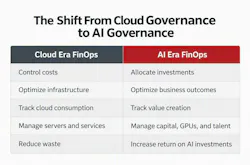
And the issue isn't just forecast accuracy. When assumptions change quickly, annual planning cycles become less useful. Leaders who reassess AI investments only during traditional annual budget reviews risk overfunding low-value initiatives and underinvesting in successful projects.
FinOps is changing as GPUs are becoming strategic assets
AI introduces a resource many FinOps programs were never designed to manage: GPUs.
Organizations need to do more than acquire additional compute capacity. That means AI turns GPU management into a portfolio-allocation problem.
Every GPU assigned to one initiative is capacity unavailable to another. The challenge isn’t simply providing infrastructure; it's deciding which initiatives deserve access to scarce compute resources. Without visibility into utilization and outcomes, IT leaders risk dedicating scarce compute resources to lower-value projects, while higher-value opportunities wait.
The FinOps Foundation includes these best practices in its recommendations:
- Treat GPUs as strategic assets rather than routine infrastructure expenses.
- Continuously monitor utilization and allocation.
- Evaluate managed versus self-hosted deployment options.
- Establish executive review processes that align GPU allocation with expected business outcomes.
FinOps is becoming a framework for AI investment governance
The AI era is forcing FinOps to evolve from a cost-management function into a portfolio-management discipline. The organizations that succeed won't necessarily be the ones that spend less on AI. They'll be the ones that consistently direct scarce capital, talent and compute resources toward the initiatives creating the greatest business value.
About the Author
 Theresa Houck
 Theresa Houck
Contributor
Theresa Houck is an award-winning B2B journalist with more than 35 years of experience covering industrial markets, strategy, policy, and economic trends. As Senior Editor at EndeavorB2B, she writes about IT, OT, AI, manufacturing, industrial automation, cybersecurity, energy, data centers, healthcare, and more. In her previous role, she served for 20 years as Executive Editor of The Journal From Rockwell Automation magazine, leading editorial strategy, content development, and multimedia production including videos, webinars, eBooks, newsletters, and the award-winning podcast “Automation Chat.” She also collaborated with teams on social media strategy, sales initiatives, and new product development.
Before joining EndeavorB2B, she was an Industry Analyst at Wolters Kluwer in its human resources book publishing operation. Before that, she spent 14 years with the Fabricators & Manufacturers Association, Intl., serving as Executive Editor of four magazines in the sheet metal forming and fabricating sector, where she managed and executed editorial strategy, budgets, marketing, book publishing, and circulation operations, and negotiated vendor contracts.
Houck holds a Master of Arts in Communications from the University of Illinois Springfield and a Bachelor of Arts in English from Western Illinois University.
 Resources
Quiz
Your Competitive Edge, DeliveredStay ahead of the curve with weekly insights into emerging technologies, cybersecurity, and digital transformation. TechEDGE brings you expert perspectives, real-world applications, and the innovations driving tomorrow’s breakthroughs, so you’re always equipped to lead the next wave of change.