How Should CIOs Budget for AI Compliance Costs in 2027?
Key Highlights
- AI governance, monitoring, documentation and oversight are becoming permanent operating costs that must be budgeted alongside AI technology investments.
- Organizations can't accurately forecast regulatory spending until they identify everywhere AI is deployed.
- The true cost of AI extends beyond licenses and infrastructure to include evidence management, training, vendor governance and compliance operations.
- The biggest budgeting risk may not be AI itself, but the cost of retrofitting governance after AI is already deployed at scale.

One of your company’s business units wants to deploy a $50,000 AI application.
On paper, it looks like a straightforward technology purchase. In reality, the costs might also include vendor assessments, monitoring tools, documentation, employee training, governance reviews, audit evidence, legal oversight and ongoing compliance activities.
Suddenly, the $50,000 application isn’t just a $50,000 decision.
As AI regulations move from policy discussions to enforcement, organizations are discovering that buying AI and governing AI are two very different expenses.
For CIOs, CTOs, CISOs, CSOs, COOs and other tech leaders, that reality is reshaping the 2027 budgeting conversation. Governance, monitoring, documentation and oversight are becoming permanent operating costs that must be funded alongside the technology itself.
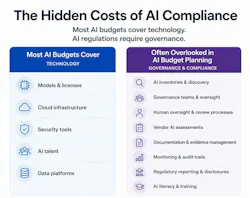
Companies that recognize this early can budget accordingly. Those that don't might find themselves scrambling to build governance programs after AI systems are already embedded across the business — and that would be a nightmare.
Why AI compliance is becoming an operating cost
By 2027, enterprises could be operating dozens or hundreds of AI-enabled applications across the business, if you aren’t already.
You don't have to comply with just a single law. You have to manage overlapping requirements from the EU AI Act, U.S. state laws, industry regulations, privacy rules, internal policies and AI-related contractual obligations.
The real cost likely won't be fines. It will be governance at scale.
The EU has adopted a comprehensive risk-based framework through the AI Act, while the United States relies more heavily on sectoral and state-level approaches. That can leave multinational organizations facing different requirements based on where customers, employees, data and operations are located.
The EU AI Act also illustrates why compliance cannot be treated solely as a legal issue. Under Article 26, deployers of certain high-risk systems must implement controls such as monitoring, recordkeeping and human oversight.
Meeting those obligations often requires investments in AI inventories, monitoring platforms, data lineage, documentation, training, vendor oversight, audit support and evidence retention. These costs turn compliance into an ongoing operational expense rather than a one-time legal review.
That's the budgeting shift for 2027: Compliance is becoming part of the cost of running AI.
How can you budget for AI you can't see?
Many organizations still don't know how many AI systems they're operating.
Do you know about the AI features embedded in HR systems, CRM platforms, analytics tools, productivity suites, cybersecurity products, customer service applications or industry-specific software? Some AI deployments may have originated within business units with little visibility from central IT.
The companies that scale AI most effectively won't necessarily spend the least on governance. They'll budget for it from the start.
Before forecasting regulatory spending, you need to understand the scope of their AI footprint.
Governance experts increasingly view AI inventories as a foundation for compliance because organizations cannot assess or manage systems they haven't identified. OneTrust's report, Governing AI in 2026: A Global Regulatory Guide, highlights the importance of maintaining visibility into AI use as regulatory obligations expand.
Before budgeting for AI governance, leaders should know:
- How many AI systems exist?
- Who owns them?
- Which AI systems affect employees or customers?
- Which AI systems across multiple jurisdictions?
- Which are supplied by vendors?
- Which AI systems require documentation or human oversight?
- Which generate evidence that may be needed for audits?
Without that inventory, regulatory budgeting is largely guesswork. Organizations may need to spend money simply to determine their AI footprint, and that effort deserves a place in the 2027 budget.
What is the fully loaded cost of an AI application?
Executives already understand the concept of a fully loaded employee cost. Salary isn't the whole number. Benefits, training, equipment and support functions must also be included.
AI investments increasingly require the same treatment.
The fully loaded cost of an AI system can include:
- Software and licensing.
- Cloud consumption.
- Security controls.
- Monitoring and testing.
- Documentation.
- Governance reviews.
- Employee training.
- Vendor oversight.
- Audit support.
- Evidence retention.
As regulatory requirements mature, the gap between purchase price and fully loaded cost can become significant.
Organizations increasingly need to retain evidence behind their governance processes. Colorado's Automated Decision-Making Technology law, for example, requires covered organizations to retain records needed to demonstrate compliance for at least three years.
Requirements under the EU AI Act also translate governance expectations into operational activities involving documentation, transparency, monitoring, disclosure and recordkeeping. The European Commission's AI policy and regulatory resources detail the broader framework.
That can require infrastructure and processes for maintaining AI inventories, approval records, testing results, monitoring logs, incident histories, data lineage records, model documentation and vendor documentation.
In other words, budget for evidence, not just policies.
But that doesn't mean organizations need a separate AI compliance budget. In fact, creating one could hide where the money is actually being spent, as illustrated in this table:
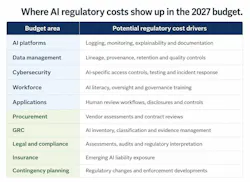
Regulatory costs are more likely to appear throughout the technology and business budget than under a single AI governance line item. As the figure above illustrates, AI regulatory spending can surface across platforms, data management, cybersecurity, workforce training, procurement, GRC, legal, insurance and contingency planning.
The better approach is to identify where regulatory costs surface throughout the technology budget rather than trying to isolate them under a single line item.
And don't forget the people cost. AI governance also requires spending on AI literacy, oversight and governance training for workers responsible for deploying, managing and reviewing AI.
What hidden AI governance costs should be in your 2027 budget?
Many companies aren't building most of their AI. They're buying it. But that doesn't necessarily remove their governance responsibilities.
Colorado's Automated Decision-Making Technology law, for example, creates obligations for both developers and deployers of covered AI systems.
The EU AI Act also distinguishes between provider and deployer obligations, adding another consideration when organizations procure third-party AI. AI provider Openlayer published a good reference explaining those provider and deployer responsibilities.
For IT and procurement leaders, that turns regulatory risk into vendor and procurement risk.
Organizations may need to budget for:
- Vendor inventories.
- Risk assessments.
- Documentation reviews.
- Contract negotiations.
- Compliance monitoring.
- Validation testing.
- Replacement planning.
Replacement planning is especially easy to overlook. If an AI vendor cannot provide sufficient documentation, testing evidence, transparency information or audit support, the organization could face replacement costs it never anticipated.
The governance workload doesn't stop after the initial vendor review. Leaders also need to consider who conducts AI assessments, who validates model documentation and how governance processes adapt when vendors modify their models.
These activities are often spread across multiple departments and budgets, making the true operating cost of AI difficult to see. An AI project that looks attractive based on licensing and infrastructure costs alone may look very different once ongoing governance requirements are included.
This also gives leaders better information when deciding whether an existing AI application is worth remediating, replacing or retiring.
How can standardization reduce AI compliance costs?
Organizations operating under the same regulatory requirements can have very different compliance costs.
Companies with standardized AI platforms, monitoring systems, evidence repositories and governance processes can spread compliance costs across many applications. Organizations supporting multiple tools and disconnected processes often duplicate those costs repeatedly.
Instead of repeatedly funding inventories, documentation systems, approval workflows, monitoring tools and evidence repositories across dozens of projects, leaders can build many of those capabilities once and reuse them.
10 Questions to Ask Before Finalizing Your 2027 AI Regulations Budget
Most organizations budget for AI technology. Fewer budget for AI regulation and governance.
Use these questions to identify potential blind spots, based on guidance from EU AI Act Article 26, the OneTrust Global Regulatory Guide 2026, and Colorado SB26-189:
- Do we have a complete inventory of AI systems across the enterprise?
- Which AI systems make or influence decisions affecting customers, employees or business operations?
- How much AI is embedded in vendor applications?
- Do we have a centralized process for AI risk classification?
- Can we produce audit evidence for every significant AI system?
- How much are we budgeting for AI monitoring, logging and documentation?
- Where will AI literacy and oversight training be funded?
- Do we have enough internal expertise, or will we need outside specialists?
- What is our process if a strategic AI vendor can’t meet future regulatory requirements?
- Have we established a contingency reserve for new regulations and compliance changes?
As AI adoption scales, that becomes increasingly valuable.
In other words, architecture standardization isn't only a technology decision. It can also be a compliance cost-control strategy.
The cost leaders are most likely to underestimate
The biggest AI budgeting risk in 2027 may not be regulatory fines. And it might not be the AI itself.
It just might be retrofitting compliance after deployment.
Companies that deploy AI widely and try to add governance later can face remediation costs because inventories, documentation, controls, oversight mechanisms and monitoring systems must be added after the fact.
That makes governance easier to fund when it's built into AI investments from the beginning.
The organizations that scale AI most effectively won't necessarily be the ones spending the least on governance. They'll be building governance into the platform, budgeting for it early and reusing those capabilities across the enterprise.
As AI adoption accelerates, the competitive advantage may come from knowing its true cost before everyone else does.
About the Author
 Theresa Houck
 Theresa Houck
Contributor
Theresa Houck is an award-winning B2B journalist with more than 35 years of experience covering industrial markets, strategy, policy, and economic trends. As Senior Editor at EndeavorB2B, she writes about IT, OT, AI, manufacturing, industrial automation, cybersecurity, energy, data centers, healthcare, and more. In her previous role, she served for 20 years as Executive Editor of The Journal From Rockwell Automation magazine, leading editorial strategy, content development, and multimedia production including videos, webinars, eBooks, newsletters, and the award-winning podcast “Automation Chat.” She also collaborated with teams on social media strategy, sales initiatives, and new product development.
Before joining EndeavorB2B, she was an Industry Analyst at Wolters Kluwer in its human resources book publishing operation. Before that, she spent 14 years with the Fabricators & Manufacturers Association, Intl., serving as Executive Editor of four magazines in the sheet metal forming and fabricating sector, where she managed and executed editorial strategy, budgets, marketing, book publishing, and circulation operations, and negotiated vendor contracts.
Houck holds a Master of Arts in Communications from the University of Illinois Springfield and a Bachelor of Arts in English from Western Illinois University.
 Resources
Quiz
Your Competitive Edge, DeliveredStay ahead of the curve with weekly insights into emerging technologies, cybersecurity, and digital transformation. TechEDGE brings you expert perspectives, real-world applications, and the innovations driving tomorrow’s breakthroughs, so you’re always equipped to lead the next wave of change.