How to Answer the 3 Technology Questions Corporate Boards Are Asking
Key Highlights
- Boards expect IT leaders to demonstrate financial returns, AI competitiveness, and the business consequences of cybersecurity risks.
- CIOs should measure technology returns, benchmark AI performance and quantify cybersecurity exposure rather than simply report technical metrics.
- Effective board presentations help directors decide which investments to approve, priorities to reconsider and business risks to accept.

IT leaders are spending more time with corporate boards. That's good news for CIOs, CTOs and CISOs who have spent years trying to get technology recognized as a business priority.
But there's a catch. Directors increasingly expect technology executives to discuss financial returns, competitive advantage and business risk. Updates on cloud migrations, AI deployments or cybersecurity improvements won't necessarily answer their questions.
According to Deloitte's 2026 research, 75% of surveyed tech leaders say their boards are fully or completely involved in technology decisions. But only 17% of IT leaders have prioritized improving board communication and influence.
For IT executives preparing for their next board presentation, three key questions deserve particular attention.
1. What are we getting for our technology spending?
Boards aren't necessarily looking for smaller IT budgets. They want evidence that investments are making the business more profitable, productive or competitive.
Diligent's 2026 What Directors Think survey found that 42% of directors expected technology to dominate capital investments. That puts tech leaders in competition with other executives seeking funding.
Work with the CFO to agree on how technology returns are measured.
How to Respond:
Connect major investments to financial outcomes. Deloitte's analysis highlights the best practice of evaluating technology spending based on business value to determine which initiatives to expand, restructure or discontinue.
Consider a hypothetical example: Reporting that an ERP modernization is 80% complete tells directors little about its value. Explaining that it's projected to cut annual operating costs by $2 million, improve order processing productivity by 15% and pay for itself within three years makes a stronger business case.
Work with the CFO to agree on how technology returns are measured. A Boston Consulting Group analysis emphasizes aligning IT and finance on business value, including which savings count, how productivity gains are valued and whether projected benefits occur.
Use board-ready metrics such as actual versus projected savings, ROI, payback periods, operating margin improvements and revenue or productivity gains. Learn more from TBM Council guidance.
Compare results with the original business case and redirect funding when investments underperform.
Don't hide investments that aren't delivering. Explain what's changing and how management will protect the remaining capital. Directors understand investment risk. Unexplained spending is harder to defend.
2. Are we falling behind competitors in AI?
No board wants to find out competitors are using AI to cut costs, improve customer service or launch products faster while their own company is still experimenting.
But deploying AI faster doesn't necessarily create a competitive advantage. An organization could have dozens of AI applications in production and little to show for its investment. For example, PwC's 2026 Annual Corporate Directors Survey found that 55% of directors believe AI still isn't generating significant business value.
CIOs and other tech leaders need to show where AI is improving performance, how results compare with competitors, and where additional investment could make a difference.
The strongest AI strategy is the one that can show why your company is spending money and what happens if it doesn't.
How to Respond:
Measure AI's business impact, not the number of pilots launched, licenses purchased or employees using chatbots. Productivity improvements don't necessarily translate into financial returns. Identify three to five business processes where AI could improve competitiveness and establish measurable targets.
For example, a manufacturer could measure whether predictive maintenance reduces downtime and production costs. A financial services company might evaluate whether AI-assisted underwriting speeds up decision-making without increasing losses.
Benchmark against competitors, but distinguish verified results from estimates and marketing claims. Use industry benchmarks, financial results and operational measures to identify gaps. Tell directors where comparisons are reliable and where information is incomplete.
Present an AI investment assessment that answers four questions:
- Where is AI delivering measurable financial or operational returns
- Where are competitors gaining an advantage, and how confident are we?
- What data, infrastructure or workforce gaps are limiting progress
- Which investments should we accelerate, improve or discontinue?
Include the cost of scaling successful pilots. An October 2026 Gartner analysis warns that pilots can conceal financial, operational and security problems that emerge during enterprise deployment. An application that looks profitable with 100 users may have different economics at 20,000 employees, especially after infrastructure, integration and operating costs are included.
The strongest AI strategy isn't necessarily the most aggressive. It's one that demonstrates competitive value, what that advantage costs and the risks of falling behind.
3. What is our actual cybersecurity risk exposure?
Boards need more than mere assurances that defenses are improving. They need to understand how an incident could affect operations, profitability and recovery.
The National Association of Corporate Directors' (NACD) 2026 cybersecurity oversight guidance recommends treating cybersecurity as a business risk, including its financial and operational consequences. That’s simply a best practice. So, explain the company's greatest exposures, recovery capabilities and whether remaining risks are acceptable.
How to Respond:
Translate cybersecurity exposure into financial and operational consequences. Instead of reporting that 95% of critical vulnerabilities have been fixed, for example, consider explaining how a ransomware attack could shut down a distribution center for several days, delaying shipments and potentially causing lost sales or contractual penalties.
Give directors a clear picture of four factors:
- Business impact: Vulnerable operations and potential losses from disruption.
- Recovery readiness: How quickly critical services can be restored, based on actual testing.
- Emerging exposure: Risks from third parties, AI deployments, acquisitions or geopolitical developments.
- Remaining risk: Exposures reduced, those still present and the cost of additional protection.
Quantify financial exposure where reasonable, but distinguish modeled estimates from known losses. False precision won't make a cyber risk assessment more credible.
Most importantly, present decisions — not just risks. Should the company invest in backup capabilities to reduce potential downtime from five days to one? Does remaining exposure exceed agreed risk tolerance? Should an acquisition proceed before identified cybersecurity weaknesses are addressed?
These decisions turn a cybersecurity briefing into a strategic board discussion.
How IT leaders can prepare for board discussions
Board readiness starts well before the meeting. Work with finance, operations, risk management and other business leaders to agree on financial outcomes, competitive priorities and risks.
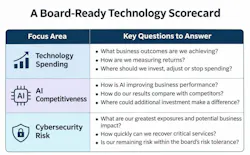
A consistent technology scorecard, like the one illustrated in the table above, can help. It should show performance trends, explain changes and identify decisions requiring board attention, including investments to approve, risks to accept or priorities to reconsider.
And a helpful hint: Provide materials in advance so directors can focus on strategic choices rather than technical details.
A CIO who can explain factors like why a $10 million investment should proceed, its expected financial return and the risks of delaying it is doing more than reporting on IT performance.
That's when technology leaders move from explaining technology decisions to helping shape business strategy.
About the Author
 Theresa Houck
Contributor
Theresa Houck is an award-winning B2B journalist with more than 35 years of experience covering industrial markets, strategy, policy, and economic trends. As Senior Editor at EndeavorB2B, she writes about IT, OT, AI, manufacturing, industrial automation, cybersecurity, energy, data centers, healthcare, and more. In her previous role, she served for 20 years as Executive Editor of The Journal From Rockwell Automation magazine, leading editorial strategy, content development, and multimedia production including videos, webinars, eBooks, newsletters, and the award-winning podcast “Automation Chat.” She also collaborated with teams on social media strategy, sales initiatives, and new product development.
Before joining EndeavorB2B, she was an Industry Analyst at Wolters Kluwer in its human resources book publishing operation. Before that, she spent 14 years with the Fabricators & Manufacturers Association, Intl., serving as Executive Editor of four magazines in the sheet metal forming and fabricating sector, where she managed and executed editorial strategy, budgets, marketing, book publishing, and circulation operations, and negotiated vendor contracts.
Houck holds a Master of Arts in Communications from the University of Illinois Springfield and a Bachelor of Arts in English from Western Illinois University.
 Resources
Quiz
Related


 Your Competitive Edge, Delivered
Stay ahead of the curve with weekly insights into emerging technologies, cybersecurity, and digital transformation. TechEDGE brings you expert perspectives, real-world applications, and the innovations driving tomorrow’s breakthroughs, so you’re always equipped to lead the next wave of change.