How CTOs Can Align Technology Investments With Product Strategy, Board Priorities and Revenue Growth
Key Highlights
- Investors and boards of directors fund outcomes, not technology.
- The CTO role is evolving. They’re expected to be business strategists who use metrics to connect technology, product development, operations, profitability, resilience and growth objectives.
- Outcome-based roadmaps replace project-based planning by focusing technology initiatives on measurable business results rather than technical deliverables.
- Technology and product strategies must align to better address customer needs, prioritize investments and accelerate business value.

While boards of directors and investors fund AI, cloud, cybersecurity, automation and digital transformation initiatives, investors are asking tougher questions about how these investments drive growth, profitability, resilience and long-term enterprise value.
Meanwhile, executive surveys show organizations are moving beyond experimentation and prioritizing measurable returns, operational improvements and revenue impact.
At the same time, the CTO role is evolving. They’re expected to be business strategists who connect technology, product development, operations and growth objectives.
For example, McKinsey & Company’s State of AI in 2025 research found that while most organizations are using AI, few have scaled deployments to achieve enterprise-level financial impact. The findings reinforce the need to align technology investments with measurable outcomes, including growth, innovation, efficiency and profitability.
So, a CTO’s challenge is ensuring technology investments directly support business outcomes that investors and boards of directors care about.
What do boards and investors actually want from technology investments?
Most boards and investors evaluate technology initiatives through a business lens.
Their priorities typically include:
- Revenue growth.
- Margin improvement.
- Customer retention.
- Operational efficiency.
- Risk reduction.
- Competitive differentiation.
- Faster innovation.
As a result, boards often ask questions such as:
- How will this investment increase revenue?
- How will it reduce costs?
- What risks does it mitigate?
- When will the business realize value?
- How will success be measured?
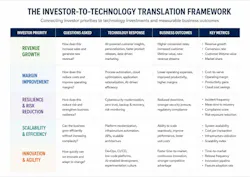
Why it matters: Investors fund outcomes, not technology (see Table 1).
Build outcome-based roadmaps instead of project-based roadmaps
Many technology roadmaps are still organized around projects such as:
- Infrastructure upgrades.
- Software deployments.
- Cloud migrations.
- Security initiatives.
While these initiatives may be necessary, they do not always show how technology investments contribute to growth, profitability or customer value.
Effective CTOs are shifting from project-based roadmaps to outcome-based roadmaps that focus on business results rather than technical deliverables. Instead of asking, “What technology should we deploy?” they ask, “What business outcome are we trying to achieve?”
Outcome-based roadmaps prioritize objectives such as:
- Accelerating product launches.
- Improving customer experience.
- Reducing operational costs.
- Increasing organizational resilience.
- Supporting market expansion.
For example, instead of defining an initiative as, “Deploy an AI platform,” an outcome-based roadmap might define success as, “Reduce customer onboarding time by 40% through AI-driven automation.”
This shift requires technology and product organizations to work together rather than operate in parallel. When strategies are disconnected, organizations can face challenges such as:
- Products customers don’t need.
- Features delivered too slowly.
- Technical debt that limits innovation.
- Misaligned investment priorities.
To create a roadmap that connects customer needs, business objectives and tech investments, CTOs should collaborate with:
- Chief Product Officers.
- Product managers.
- Revenue leaders.
- Operations executives.
According to Gartner Digital Business Strategy Research, IT leaders who effectively connect technology investments to business capabilities are better positioned to generate value from digital initiatives.
Warning Signs Your Technology Roadmap is Misaligned
- Projects are prioritized by technical urgency rather than business impact.
- Roadmap discussions rarely involve revenue leaders.
- Success metrics focus on implementation instead of outcomes.
- Business stakeholders can’t explain how initiatives support growth.
- Board presentations emphasize technology activities instead of business results.
What to do: Instead of asking, “What features should we build?” ask, “What customer problem creates the greatest business opportunity?”
When customer and business priorities are clear, technology decisions become more focused, investments are easier to prioritize, and technology becomes an enabler of business strategy rather than the objective itself.
Align product and technology strategy
Technology and product teams often operate on separate tracks.
When that happens, organizations frequently encounter:
- Products customers don’t need.
- Slow feature delivery.
- Growing technical debt.
- Conflicting investment priorities.
To create a unified roadmap, CTOs should collaborate closely with:
- Chief Product Officers.
- Product managers.
- Revenue leaders.
- Operations executives.
According to McKinsey & Company's Technology Trends Outlook 2025 report, organizations that connect technology investments to business capabilities are better positioned to generate value from digital initiatives.
5 Questions Every Board Member Asks About Technology Spending
Technology proposals that answer these questions are more likely to gain approval and funding.
- How will this investment support revenue growth? Board members will want to know if the investment helps acquire new customers, improve customer retention, enable new products, etc.
- What business problem are we solving? Technology projects should address a clearly defined business challenge. Connect investments to growth, efficiency, resilience, risk management and long-term enterprise value.
- How will success be measured? Boards of directors expect clear metrics showing projected improvement before approving funding.
- What risks does this investment reduce? Technology spending is often justified as much by risk reduction as by growth potential.
- What return should we expect and when? Boards want realistic expectations regarding value realization. And not all returns are financial — some generate value through resilience, agility, innovation and competitive advantage.
Decision framework: When customer needs and business priorities are clear, technology becomes an enabler rather than the objective itself. Before approving any major technology initiative, ask:
- What customer problem are we solving?
- What business opportunity does it create?
- Which strategic objective does it support?
- How will success be measured?
Why it matters:
- Investors care about outcomes, not technology projects.
- Every roadmap initiative should support a measurable business objective.
- Technology spending should be translated into revenue, efficiency or risk-reduction metrics.
Use metrics that connect technology to business performance
With customer, business and technology decisions aligned, the next step is measuring impact. CTOs increasingly rely on engineering and operational metrics to determine whether tech investments are creating business value.
Industry research, including the Google Cloud State of DevOps (DORA) Research 2025 report, indicates organizations that combine strong engineering practices, software delivery performance, business alignment, governance and customer-focused operating models are better positioned to translate tech investments into measurable outcomes.
Relevant metrics include:
Reliability metrics
- Mean Time to Recovery (MTTR)
- Service availability
- Incident frequency
Delivery metrics
- Deployment frequency
- Lead time for changes
- Change failure rate
Efficiency metrics
- Infrastructure cost efficiency
- Cloud utilization
- Engineering productivity
Business metrics
- Revenue per engineering employee
- Customer retention
- Feature adoption
- Product engagement
CTOs must also communicate technology performance in the language of investors and boards of directors by connecting technical achievements to business results.
Questions CTOs Should Ask Before Approving a Technology Initiative
✓ Does it support a revenue objective?
✓ Does it improve customer experience?
✓ Does it reduce operational costs?
✓ Does it accelerate product delivery?
✓ Can we measure business impact?
For example, instead of reporting achievements like:
- Cloud migration is 70% complete.
- Security platform deployed.
- Data lake implementation finished.
Explain the business impact, such as:
- Reduced operating costs by 15%.
- Increased digital sales conversion by 12%.
- Shortened product launch cycles by 30%.
- Reduced cyber risk exposure across critical operations.
What to do next: Review your technology dashboard. If most metrics focus on technical activity rather than business outcomes, add measurements that directly connect technology performance to revenue, efficiency, customer experience and risk reduction.
Identify the business capabilities that drive growth
Technology investments should strengthen capabilities that directly influence revenue and competitive advantage.
Examples include:
- Digital customer engagement.
- Data analytics.
- Product innovation.
- Supply chain visibility.
- Automation.
- AI-powered decision support.
Questions CTOs should ask:
- Which capabilities generate revenue?
- Which capabilities improve customer retention?
- Which capabilities accelerate market entry?
- Which capabilities create competitive differentiation?
Prioritizing capabilities over technologies helps organizations focus on investments that create the greatest business value.
CTOs who communicate in business terms are more likely to gain executive support, board confidence and investment funding.
Translate technology spending into business value
Tech leaders understand the technical implications of an investment, but investors and board members evaluate those same investments differently. They focus on:
- Revenue.
- Profitability.
- Productivity.
- Scalability.
- Risk.
What to do next: Create executive dashboards that report business outcomes rather than implementation status.
And replace technology activity metrics with measures tied to growth, efficiency, profitability, resilience and risk reduction.
Metrics that matter to executives include:
- Revenue generated per digital initiative.
- Cost-to-serve reduction.
- Cost per transaction.
- Time-to-market improvements.
- Customer acquisition costs.
- Productivity gains.
How to build a roadmap the board can understand
A common mistake is presenting roadmaps filled with technical terminology. But boards of directors rarely make investment decisions based on tech features.
They make decisions based on business outcomes.
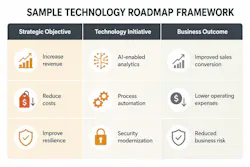
Create a technology roadmap that visibly shows boards and investors how the CTO’s strategic objectives lead to a technology objective, that then produces a desired business outcome (see Table 2).
Why it matters: Every roadmap item should have a clearly defined business outcome attached to it.
Measure return on objectives, not just return on investment
Traditional ROI remains important, of course. But many strategic initiatives create value beyond direct financial returns.
These additional measures include:
- Time to market.
- Customer satisfaction.
- Employee productivity.
- Risk reduction.
- Regulatory compliance.
- Innovation velocity.
Return-on-objectives framework. For every initiative, define:
✓ Business objective.
✓ Success metrics.
✓ Expected timeline.
✓ Executive sponsor.
Why it matters: This creates accountability while providing investors with a clearer understanding of expected value.
Make revenue growth a shared responsibility
Revenue growth is no longer solely a sales or product function.
Growth strategies increasingly depend on technology.
Initiatives involving AI, automation, analytics, digital services and data monetization require collaboration across multiple functions.
So, successful CTOs regularly partner with:
- CFOs.
- COOs.
- Product leaders.
- Marketing executives.
- Business-unit leaders.
When these stakeholders participate in roadmap planning, tech priorities become more closely aligned with customer needs, operational requirements and revenue objectives — enabled by technology.
The CTO as a business value leader
Technology roadmaps are no longer just planning documents; they are strategic frameworks that shape growth, profitability, resilience and enterprise value.
As boards and investors increase scrutiny of technology spending and AI investments, CTOs must connect technology initiatives to measurable business outcomes, align roadmaps with business strategy, and communicate impact in terms executives understand.
The modern CTO is no longer just managing technology projects but leading technology as a driver of business value and long-term growth.
About the Author

Theresa Houck
Contributor
Theresa Houck is an award-winning B2B journalist with more than 35 years of experience covering industrial markets, strategy, policy, and economic trends. As Senior Editor at EndeavorB2B, she writes about IT, OT, AI, manufacturing, industrial automation, cybersecurity, energy, data centers, healthcare, and more. In her previous role, she served for 20 years as Executive Editor of The Journal From Rockwell Automation magazine, leading editorial strategy, content development, and multimedia production including videos, webinars, eBooks, newsletters, and the award-winning podcast “Automation Chat.” She also collaborated with teams on social media strategy, sales initiatives, and new product development.
Before joining EndeavorB2B, she was an Industry Analyst at Wolters Kluwer in its human resources book publishing operation. Before that, she spent 14 years with the Fabricators & Manufacturers Association, Intl., serving as Executive Editor of four magazines in the sheet metal forming and fabricating sector, where she managed and executed editorial strategy, budgets, marketing, book publishing, and circulation operations, and negotiated vendor contracts.
Houck holds a Master of Arts in Communications from the University of Illinois Springfield and a Bachelor of Arts in English from Western Illinois University.
 Resources
Quiz
Your Competitive Edge, DeliveredStay ahead of the curve with weekly insights into emerging technologies, cybersecurity, and digital transformation. TechEDGE brings you expert perspectives, real-world applications, and the innovations driving tomorrow’s breakthroughs, so you’re always equipped to lead the next wave of change.