Six IT Decisions That Make Sense No Matter Who Wins the 2026 Midterms
Key Highlights
- IT leaders should build 2027 technology strategies around multiple policy scenarios instead of trying to predict the midterm elections.
- Flexible AI governance and data architectures can help enterprises adapt as federal and state regulatory requirements evolve.
- AI security, energy availability and supply-chain concentration are increasingly strategic technology risks that demand executive attention.
- Stress-testing major investments can reveal where regulatory, geopolitical or cost changes could undermine 2027 technology plans.

The 2026 midterm elections arrive at a time when government policy and technology strategy are increasingly intertwined.
AI governance, cybersecurity, privacy, semiconductor supply chains, data-center expansion, energy policy and trade policy are all influenced by decisions in Washington and state capitals.
But waiting for political clarity is not a winning strategy. The more useful question is, “What technology decisions make sense under multiple policy scenarios?”
The enterprises best positioned after Nov. 3 will be those that build technology strategies flexible enough to succeed across several possible outcomes.
Here are six decisions worth making now.
1. Build AI governance that can survive regulatory change
AI regulation may evolve differently depending on election outcomes, but one trend is consistent: greater scrutiny of how AI systems are governed, documented and validated.
States continue advancing their own AI rules. For example, California recently enacted SB 813 and AB 1405, establishing a framework for independent verification organizations and standards for AI auditors. At the federal level, proposals range from limiting some state AI rules to requiring independent assessments of frontier AI developers.
What should an enterprise AI governance inventory include?
An enterprise AI governance inventory should document every AI system's purpose, ownership, data use, risk classification, oversight requirements and security controls. NIST recommends maintaining an inventory of AI systems and related documentation. At minimum, identify the following:
- System: What AI systems and models are in use?
- Owner: Who is accountable?
- Purpose: What process or decision does it support?
- Data: What data does it use?
- Impact: Who is affected by its outputs?
- Risk: How is it classified?
- Oversight: Where is human review required?
- Controls: What security, privacy and risk controls apply?
- Response: What happens if it fails or causes harm?
The executive test: If a regulator, board member or customer asks where AI influences important decisions in your organization, could you answer?
Source: NIST SI Resource Center
Regardless of where policymakers land, enterprises should expect increasing pressure to demonstrate that AI systems are properly governed and controlled.
Your decision: Build governance capabilities that remain useful regardless of how regulation evolves.
That includes:
- Maintaining an inventory of AI models and where they're used.
- Classifying AI systems by risk.
- Documenting controls and maintaining audit trails.
- Defining when human review is required and who is accountable.
- Preparing for independent assessments of AI systems and controls.
If regulations become more stringent, you'll be ahead. If they don't, you'll still have stronger visibility and control over AI across the business.
2. Design data architecture for regulatory flexibility
The bigger challenge may not be federal regulation. It may be dozens of different state requirements.
Twenty-three states now have comprehensive privacy laws, while additional legislation continues to emerge around AI, biometrics, automated decision-making and health data.
For enterprises, regulatory compliance increasingly depends on data architecture as well as legal policies.
Your decision: Design systems for regulatory flexibility.
Data governance platforms, identity systems, consent management tools, retention policies and AI controls should accommodate jurisdiction-specific requirements without major redesigns.
Organizations that build that flexibility now will likely spend less time and money reacting later.
3. Fold AI security into cybersecurity strategy
Many organizations still treat AI governance and cybersecurity as separate programs. That distinction is becoming harder to maintain.
The Congressional Research Service has identified growing policy concerns around agentic AI, including AI-enabled attacks, model testing and information sharing. Meanwhile, the World Economic Forum’s Global Cybersecurity Outlook 2026 found that 94% of surveyed leaders expect AI to be the most significant driver of cybersecurity change in 2027.
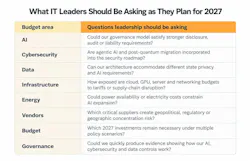
As AI gains access to workflows, enterprise systems and decision-making processes, governance and security increasingly overlap.
Your decision: Integrate AI security into your enterprise cybersecurity program.
AI risk assessments, red teaming, monitoring, identity controls, incident response planning and model-security reviews should become part of the core cybersecurity program rather than a standalone AI effort.
4. Identify technology supply chain risks and vendor dependencies
Technology supply chains remain exposed to geopolitical and trade-policy shifts.
The administration has imposed tariffs on certain semiconductor imports and outlined the possibility of additional semiconductor-related trade actions. Beyond tariffs, concentration risk poses another significant challenge.
Many organizations depend heavily on a small number of cloud providers, AI platforms, chip suppliers and networking vendors.
Your decision: Identify the dependencies that could materially affect your business.
Determine which vendors, platforms or suppliers could create operational, financial or regulatory risks if costs rise, availability declines or policies change.
Assess where alternative vendors or sourcing arrangements may be needed to reduce exposure without disrupting critical partnerships.
5. Account for power availability in AI infrastructure planning
Power availability is becoming a technology issue.
Congress is considering proposals related to data-center energy use and infrastructure, while IDC recently increased its forecast for 2026 AI infrastructure spending to $497 billion.
As AI investment accelerates, infrastructure decisions increasingly depend on energy availability, utility costs, geography, permitting and transmission capacity.
A company may have the budget for additional AI capacity but discover that power availability or utility costs become the real constraint.
Your decision: Incorporate energy planning into infrastructure planning.
Ask questions such as:
- Could power availability limit future AI initiatives?
- Are utility costs affecting long-term infrastructure economics?
- Does geography restrict expansion options?
- Could local permitting or community concerns affect future projects?
Infrastructure strategy and energy strategy are becoming increasingly difficult to separate.

How to Election-Proof Supply Chain Decisions for IT Leaders
IT leaders can reduce post-election supply-chain risk by evaluating critical vendor dependencies, preparing alternative sourcing options and stress-testing procurement plans against potential policy changes. Use this framework to identify the decisions worth making now.
✓ If hardware refreshes are critical over the next 12-24 months: Lock in key purchases earlier than planned rather than assuming component costs will stabilize after the election.
✓ If a critical supplier depends heavily on a single country: Develop an alternative source now, even if current pricing is less attractive.
✓ If your cloud, networking or security roadmap depends on one vendor: Assess substitute products and deployment options before they become urgent.
✓ If AI is driving future infrastructure plans: Build flexibility into capacity forecasts because chip availability, power constraints and supply-chain disruptions may persist regardless of political outcomes.
✓ If contracts are being negotiated in 2027: Include pricing, sourcing and delivery contingencies that remain workable under multiple trade-policy scenarios.
Don't try to predict the election. Stress-test sourcing decisions against multiple policy outcomes and choose your options that remain viable in all of them.
6. Build your 2027 technology portfolio around scenarios, not forecasts
Many enterprises still build plans around a single expected future. That's becoming harder to justify.
A change in congressional control doesn't automatically reverse tariffs, cybersecurity priorities or technology-related executive actions. Likewise, unified government doesn't guarantee consensus on AI regulation, privacy or technology policy.
Planning for multiple political outcomes helps IT leaders reduce risk and avoid overcommitting to a single policy scenario.
Your decision: Stress-test major investments against several plausible scenarios.
Identify where changes in regulation, trade policy, operating costs, energy availability or geopolitical conditions could affect the 2027 technology portfolio.
Effective scenario planning establishes which developments would warrant reassessing an investment or changing course. The strongest investments can continue delivering value across multiple potential outcomes.
How can IT leaders prepare for post-election technology uncertainty?
IT leaders can prepare for post-election uncertainty by stress-testing their 2027 technology plans, identifying investments vulnerable to policy changes and building flexibility into major decisions.
The easiest mistake IT leaders can make before the midterm elections is treating the election as a reason to delay decisions.
But waiting isn't a strategy. Clarity rarely arrives on schedule.
Whether Congress changes hands or not, organizations will still face decisions about AI governance, cybersecurity, privacy, infrastructure, energy and supply-chain resilience. The policy landscape may shift, but the need to make technology investments won't.
The organizations best positioned to navigate the post-election environment will be those that have already accounted for uncertainty in their technology strategies.
About the Author
 Theresa Houck
 Theresa Houck
Contributor
Theresa Houck is an award-winning B2B journalist with more than 35 years of experience covering industrial markets, strategy, policy, and economic trends. As Senior Editor at EndeavorB2B, she writes about IT, OT, AI, manufacturing, industrial automation, cybersecurity, energy, data centers, healthcare, and more. In her previous role, she served for 20 years as Executive Editor of The Journal From Rockwell Automation magazine, leading editorial strategy, content development, and multimedia production including videos, webinars, eBooks, newsletters, and the award-winning podcast “Automation Chat.” She also collaborated with teams on social media strategy, sales initiatives, and new product development.
Before joining EndeavorB2B, she was an Industry Analyst at Wolters Kluwer in its human resources book publishing operation. Before that, she spent 14 years with the Fabricators & Manufacturers Association, Intl., serving as Executive Editor of four magazines in the sheet metal forming and fabricating sector, where she managed and executed editorial strategy, budgets, marketing, book publishing, and circulation operations, and negotiated vendor contracts.
Houck holds a Master of Arts in Communications from the University of Illinois Springfield and a Bachelor of Arts in English from Western Illinois University.
 Resources
Quiz
Your Competitive Edge, DeliveredStay ahead of the curve with weekly insights into emerging technologies, cybersecurity, and digital transformation. TechEDGE brings you expert perspectives, real-world applications, and the innovations driving tomorrow’s breakthroughs, so you’re always equipped to lead the next wave of change.