How is Data Sovereignty Changing Enterprise Technology Strategy?
Key Highlights
- Data sovereignty is evolving from a compliance concern into a strategic issue shaping cloud, AI, vendor and market-entry decisions.
- AI adoption is tying data sovereignty strategy to governance, infrastructure control and long-term technology planning.
- Data sovereignty requirements can increase vendor lock-in, limit provider choices and complicate mergers, acquisitions and platform migrations.
- The biggest cost may be reduced strategic flexibility as organizations balance global scale against growing local digital restrictions.

Data sovereignty is becoming the digital equivalent of national airspace. Airlines can fly internationally, but they cannot cross borders however they want. Every country controls who can enter, what routes can be used and what rules apply within its airspace.
Data once moved across borders with relatively few constraints. Now, governments are treating data more like physical territory. Data sovereignty determines which legal and governance rules apply based on where data is stored and which jurisdiction controls it.
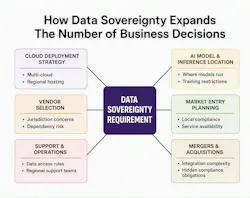
As a result, data sovereignty requirements increasingly influence cloud deployments, AI services, support operations, vendor selection and market-entry strategy.
The hidden cost of sovereignty isn’t where data sits or even compliance. It's the growing number of business decisions affected by jurisdictional boundaries. The need for these decisions becomes clear when global companies must redesign their routes, operations, technology platforms and AI strategies to adapt to a more fragmented digital landscape.
Why data sovereignty is becoming a strategic business issue
Data sovereignty is becoming a strategic business issue as governments exert greater control over data and the technologies that support it, including cloud and AI infrastructure built on strategic semiconductor supply chains. The European Commission's 2026 Technology Sovereignty Package directly links these technologies to Europe's long-term economic strategy.
And according to a NetApp analysis, several forces are driving this trend:
Rise of digital nationalism. Countries are viewing data as a strategic national asset tied to privacy, economic competitiveness and national security. More than 60 countries now have some form of data-localization requirement, up from fewer than 20 a decade ago.
Increased regulatory enforcement. Governments are imposing substantial penalties for noncompliance. GDPR-related fines have exceeded €4 billion since 2018, highlighting the financial and operational risks associated with cross-border data management.
Noncompliance can also lead to operational restrictions, reputational damage and loss of customer trust.
For IT leaders, one of the next decade's defining challenges might be balancing global operations with increasingly local digital rules.
Cloud complexity. Cloud architectures often distribute data across multiple nations and jurisdictions, creating complex obligations around storage, processing, backups and access.
Sovereignty has expanded far beyond where data is stored. The EC's Cloud Sovereignty Framework includes governance, operational control, supplier dependencies, legal jurisdiction, resilience and auditability among its objectives.
So, executives must ask:
- Who controls the underlying infrastructure?
- Which laws govern access to critical data?
- How dependent are we on foreign technology providers?
- How would geopolitical changes affect operations?
These are strategic planning questions, not merely compliance questions.
And the C-suite increasingly recognizes that reality. A 2026 Capgemini Research Institute study found that 44% of organizations now view data sovereignty as a board-level priority. Almost four in five are already implementing or developing a sovereignty strategy, while most of the remainder expect to launch one within the next 12 months.
The study also found that geopolitical uncertainty is a major driver. Four in five respondents cited geopolitical disruption as the leading reason behind their sovereignty initiatives, reflecting growing concerns about maintaining business continuity in an increasingly unpredictable environment. (To learn more, read our TechEDGE article, “Why CIOs Need to Build Geopolitical Risk Into Technology Strategy.”)
Sovereignty is also becoming a growth and market-access issue. When companies enter new markets, sovereignty requirements can affect cloud deployment options, AI services, data-sharing practices, support operations and vendor selection. What once appeared to be a technical implementation detail is becoming part of market-entry planning.
Data sovereignty is reshaping AI and cloud decisions
Generative AI has expanded sovereignty concerns beyond data storage and transfers. Organizations must now evaluate where models run, where inference occurs, who controls training infrastructure and whether critical workloads depend on providers outside their preferred jurisdiction.
As AI adoption accelerates, organizations must evaluate where data reside, who controls the infrastructure powering AI systems and how geopolitical or regulatory changes could affect that infrastructure. The result is that AI strategy and data sovereignty strategy are becoming increasingly intertwined. (Learn more about governance in our TechEDGE article, “The New Automation Stack: Who Governs AI Decisions?”)
How data sovereignty affects vendor lock-in and dependency risk
Data sovereignty can increase vendor lock-in by reducing the number of providers that meet an organization’s jurisdictional requirements.
A European Parliament briefing on cloud and AI development found that three U.S.-based providers account for about 65% of the European cloud market. Meanwhile, the EC's Cloud Sovereignty Framework highlights supplier dependencies, operational control, governance, and legal jurisdiction as key considerations for sovereignty.
Sovereignty requirements can reduce the pool of acceptable providers. While that may simplify compliance, it can also limit flexibility and influence long-term technology roadmaps.
The challenge is compounded by existing dependencies. According to Capgemini's study, 59% of organizations believe full digital sovereignty is ultimately unattainable. More than one-third estimate it would take longer than 12 months to transition away from a critical supplier, while 10% report having no viable alternative provider at all.
What is the difference between data sovereignty, data residency and data localization?
- Data Sovereignty: A legal concept that focuses on governance and control. Data is subject to the laws of the country where it’s stored, including privacy regulations, government access rights and data protection standards.
- Data Residency: A physical concept where data is geographically stored — which country, region or data center. Organizations choose residency for performance, compliance or business reasons.
- Data Localization: Regulatory requirements with laws mandating that specific types of data must be stored within a country's borders. Often enforced through data sovereignty legislation.
As a result, companies must evaluate data sovereignty alongside cybersecurity, resilience, concentration risk and financial stability when assessing technology partners.
And the issue also extends to mergers and acquisitions.
Cybersecurity, technical debt and infrastructure risk have long been standard due diligence concerns. Data sovereignty now belongs on that list. After all, acquisitions often introduce new cloud contracts, AI platforms, governance frameworks and compliance obligations. Sovereignty issues can extend integration timelines, increase costs and reduce anticipated synergies.
How data sovereignty increases IT costs and complexity
According to Gartner's sovereign cloud research, worldwide sovereign cloud infrastructure spending is expected to reach $80 billion in 2026, up more than 35% from 2025, and exceed $110 billion by 2027. Gartner also estimates that sovereignty concerns will drive about 20% of workloads from global cloud providers to local alternatives.
Those costs often appear indirectly through architectural complexity, duplicated capabilities, additional governance requirements and region-specific infrastructure.
So, executives should be asking questions like:
✓ Which applications and business processes depend on cross-border data flows?
✓ Where does the organization rely heavily on a small number of providers?
✓ How might sovereignty requirements affect future infrastructure and AI costs?
The data sovereignty premium isn’t just a compliance expense anymore; it’s becoming an operational and strategic cost that affects long-term investment decisions.
How data sovereignty affects global IT operations
Enterprise architecture spent the last decade moving toward standardization through shared cloud platforms, common data architectures and global operating models.
Now, data sovereignty is pushing in the opposite direction. As governments impose local requirements on data, cloud infrastructure and AI services, companies must support multiple clouds, region-specific AI deployments, separate governance models and different operational requirements.
Additional Resources
These resources can help you learn more about strategizing for AI and data sovereignty.
- Gartner Sovereign Cloud Forecast – Gartner
- What is Data Sovereignty? – NetApp
- Sovereignty and Data Localization – Belfer Center for Science and International Affairs, Harvard Kennedy School
- What Is Data Sovereignty: Key Requirements & Best Practices – AvePoint
- “Why CIOs Need to Build Geopolitical Risk Into Technology Strategy” – TechEDGE
The long-term risk in this situation is the gradual loss of flexibility that occurs when global technology strategies must adapt to local localization rules.
Companies spent years building integrated global tech environments to maximize efficiency, visibility and agility. Now many are balancing those benefits against growing demands for regional control and localization.
So, for IT leaders, one of the next decade's defining challenges might be preserving the advantages of global operations while adapting to an increasingly fragmented digital world.
What's the hidden cost of data sovereignty?
The real cost of sovereignty is not compliance work or infrastructure spending. It’s the gradual reduction of strategic flexibility.
As governments exert greater control over data, AI, cloud infrastructure and digital services, technology leaders must find ways to preserve the benefits of global scale while operating within increasingly local rules.
About the Author
 Theresa Houck
 Theresa Houck
Contributor
Theresa Houck is an award-winning B2B journalist with more than 35 years of experience covering industrial markets, strategy, policy, and economic trends. As Senior Editor at EndeavorB2B, she writes about IT, OT, AI, manufacturing, industrial automation, cybersecurity, energy, data centers, healthcare, and more. In her previous role, she served for 20 years as Executive Editor of The Journal From Rockwell Automation magazine, leading editorial strategy, content development, and multimedia production including videos, webinars, eBooks, newsletters, and the award-winning podcast “Automation Chat.” She also collaborated with teams on social media strategy, sales initiatives, and new product development.
Before joining EndeavorB2B, she was an Industry Analyst at Wolters Kluwer in its human resources book publishing operation. Before that, she spent 14 years with the Fabricators & Manufacturers Association, Intl., serving as Executive Editor of four magazines in the sheet metal forming and fabricating sector, where she managed and executed editorial strategy, budgets, marketing, book publishing, and circulation operations, and negotiated vendor contracts.
Houck holds a Master of Arts in Communications from the University of Illinois Springfield and a Bachelor of Arts in English from Western Illinois University.
 Resources
Quiz
Your Competitive Edge, DeliveredStay ahead of the curve with weekly insights into emerging technologies, cybersecurity, and digital transformation. TechEDGE brings you expert perspectives, real-world applications, and the innovations driving tomorrow’s breakthroughs, so you’re always equipped to lead the next wave of change.