Why CIOs and CTOs Need to Build Geopolitical Risk Into Technology Strategy
Key Highlights
- Foreign policy and geopolitical events now shape technology decisions, from AI infrastructure and semiconductors to investment planning.
- Technology sovereignty and concentration risk have become strategic considerations, not just procurement concerns.
- AI strategy increasingly depends on regulations, semiconductor access, data residency requirements and government policy.
- Resilient technology roadmaps require scenario planning, supplier risk visibility and board-level oversight.

Prefer to Listen?
News about what’s going on around the world can be disturbing enough. But when it’s affecting your job, it rises to a whole new level.
A new reality is that increasingly, IT architecture is shaped by geopolitics. Where data resides, who manufactures critical chips and what software organizations can access are no longer determined only by business requirements.
Traditional priorities like cybersecurity, cloud migration, application modernization and digital transformation are still important, of course. What's changed is the growing number of external forces that influence whether those initiatives succeed.
Now, IT leaders must account for semiconductor supply chains, export controls, tariffs, AI regulations, wars and regional conflicts, shipping disruptions, and even the electricity required to power AI infrastructure. According to the World Economic Forum's (WEF) Global Risks Report 2026, geoeconomic confrontation is now the world's top near-term risk.
This isn't about politics. It's about planning. External geopolitical forces have become architecture constraints that can influence technology decisions long before systems are deployed.
A CIO building a three-year roadmap can no longer assume that hardware will be available on schedule, that vendors will operate the same way next year or that AI infrastructure costs will remain predictable.
Why global events have become IT problems
Geopolitical developments usually landed primarily on the desks of legal teams, government affairs specialists and economists. Increasingly, they're showing up in technology planning meetings.
And recent events have demonstrated how quickly a disruption thousands of miles away can become a geopolitical choke point affecting U.S. operations.
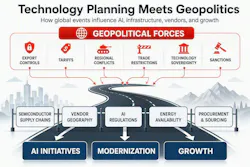
Russia's invasion of Ukraine disrupted energy markets, triggered sanctions and export controls and heightened cybersecurity concerns. Instability in the Red Sea forced shipping companies to reroute vessels around southern Africa, increasing transportation costs and delivery times. Meanwhile, competition between the United States and China has accelerated export controls, technology restrictions and domestic technology investment programs.
Together, these developments show how events thousands of miles away can affect technology budgets, procurement timelines, vendor operations and infrastructure availability.
For tech leaders, the consequences can include:
- Higher hardware and infrastructure costs.
- Procurement and deployment delays.
- AI initiatives constrained by compute availability.
- Vendor supply disruptions.
- Elevated cybersecurity risks during periods of geopolitical tension.
That means you’re increasingly accountable for risks that originate outside the enterprise. A technology roadmap that ignores geopolitical uncertainty might look reasonable on paper but prove difficult to execute when conditions change.
Vendor geography matters more than it used to
Vendor evaluations once focused primarily on features, performance, reliability and cost. Those factors still matter, of course, but many technology leaders now ask additional questions:
- Where is the company headquartered?
- Where are its development teams and key operations located?
- Could geopolitical developments create operational disruption?
These concerns reflect a broader trend toward technology sovereignty, as organizations evaluate how jurisdictional requirements, regional regulations, and cross-border dependencies could affect technology investments.
This doesn't mean avoiding global suppliers. It means recognizing that geographic exposure is now part of technology risk management. A vendor may still offer the best solution, but technology leaders need a clear understanding of the external risks that come with that relationship.
Semiconductors have become strategic infrastructure
Almost every major technology initiative depends on semiconductors, from AI and cloud infrastructure to networking, security and industrial systems. That dependence has become a strategic concern as chip manufacturing remains highly concentrated and governments increasingly treat semiconductor production as both an economic and national security priority.
Export controls, domestic manufacturing incentives and technology restrictions are reshaping global supply chains and influencing where organizations can source advanced technologies. Gartner's Top 10 Strategic Technology Trends for 2026 notes that geopolitical and regulatory complexity is becoming a larger part of tech planning.
Geopolitical Risk Checklist for IT Technology Leaders
How exposed to political and geopolitical events is your technology strategy? Ask the questions below during your annual planning and major investment reviews — if several answers are unclear, geopolitical risk may not be receiving sufficient attention in your tech planning.
✓ Which strategic initiatives depend on a small number of suppliers?
✓ Which vendors operate primarily in a single geography?
✓ Could export controls affect access to critical technology?
✓ How would a six-month hardware delay affect major projects?
✓ Do AI business cases assume unlimited compute availability?
✓ Could tariffs significantly increase infrastructure costs?
✓ Which initiatives face data residency or regulatory risks?
✓ Have supplier concentration risks been discussed with executive leadership?
✓ Have geopolitical scenarios been incorporated into investment planning?
✓ Does the board receive visibility into technology-related geopolitical risks?
Competition between the United States and China is accelerating those shifts, while countries including Japan, South Korea, India and members of the European Union are investing heavily to strengthen technology sovereignty and reduce reliance on a small number of manufacturing hubs, as noted by Deloitte’s technology sovereignty analysis.
AI has also exposed how concentrated the semiconductor ecosystem has become. Nvidia designs many of the accelerators and GPUs enterprises rely on; the Taiwan Semiconductor Manufacturing Co. (TSMC) manufactures many of them; ASML provides the lithography equipment used to produce advanced chips; and Broadcom supplies critical networking silicon.
For CIOs, CTOs and CISOs, the issue isn't which company gains market share. The issue is concentration risk. Many AI initiatives depend on a relatively small group of suppliers operating across multiple countries. A disruption affecting any link in that chain can delay deployments, increase costs and alter technology roadmaps.
You don't need to become a semiconductor expert. But you do need to understand where critical projects depend on concentrated suppliers, manufacturing regions or hardware ecosystems and how those dependencies could be affected by export controls, trade restrictions, supply disruptions or demand shocks.
AI strategy increasingly depends on government policy
Many enterprise leaders still view AI strategy through a technology lens, focusing on use cases, governance, skills and ROI.
But AI roadmaps are increasingly shaped by government policy. AI regulations, sovereign AI investments and data residency requirements can influence where organizations store data, deploy AI, select vendors and operate across borders.
A multinational company might run the same AI application in multiple markets, but face different regulatory and infrastructure requirements in each.
So, AI planning now requires leaders to monitor not only technology trends, but also the policy decisions that can shape future operations.
5 ways to build geopolitical risk into technology planning
The good news is that you don't need a foreign policy briefing before every budget meeting. You just need to recognize that some of your biggest technology risks now start outside the organization.
1. Map your critical dependencies. Most organizations know which applications are mission critical. Far fewer understand the vendors, suppliers, regions and technologies those applications depend on.
Ask questions such as:
- Which AI initiatives rely heavily on Nvidia GPUs?
- Which projects depend on TSMC manufacturing capacity?
- Which suppliers are concentrated on a single geography?
- Which systems could be affected by export restrictions or supply disruptions?
The goal isn't to eliminate dependencies, but rather to understand them before they become a problem.
2. Pressure-test AI roadmaps. Many AI business cases assume:
- Compute will remain readily available.
- Infrastructure costs will stay predictable.
- Regulations won't significantly affect deployments.
Those assumptions need to be examined.
What happens if GPU costs rise substantially? What if infrastructure delivery slips by six months? What if new regulations require additional compliance investments?
In many organizations, geopolitical risk has evolved from a business issue into a technology execution issue.
If those scenarios materially change ROI projections, they should be part of planning discussions before funding decisions are finalized.
3. Build scenarios, not forecasts. Many enterprises still plan around a single expected future. A stronger approach is to evaluate multiple possibilities, such as.
- New export controls: Hardware availability changes.
- Higher tariffs: Infrastructure costs increase.
- Expanded AI regulations: Governance spending rises.
- Supply-chain disruptions: Project timelines slip.
The objective is to avoid being surprised by these events.
4. Make the procurement team a strategic planning partner. Procurement teams often have visibility into supplier concentration risks, emerging shortages, regional sourcing challenges and vendor exposure to geopolitical disruption.
Bringing procurement, finance, risk and technology leaders together earlier can help you identify vulnerabilities before major investments are made.
5. Make geopolitical risk a board-level technology discussion. Most boards now receive regular briefings on cybersecurity and digital risk. Increasingly, they also need visibility into:
- Major supplier dependencies.
- AI infrastructure risks.
- Geographic concentrations.
- Potential impacts on multiyear investment plans.
In many organizations, geopolitical risk has evolved from a business issue into a technology execution issue.
Your next constraint likely will come from outside the enterprise
You and your IT peers have always planned around uncertainty. What's changing is where that uncertainty originates. More and more, the risks most likely to disrupt technology initiatives aren’t internal execution failures from inside your company, but external events beyond the enterprise's control.
You don’t have to predict every disruption. Your organization can adapt the fastest by understanding your dependencies, building flexibility into critical decisions, and preparing for multiple futures rather than a single expected outcome.
About the Author
 Theresa Houck
 Theresa Houck
Contributor
Theresa Houck is an award-winning B2B journalist with more than 35 years of experience covering industrial markets, strategy, policy, and economic trends. As Senior Editor at EndeavorB2B, she writes about IT, OT, AI, manufacturing, industrial automation, cybersecurity, energy, data centers, healthcare, and more. In her previous role, she served for 20 years as Executive Editor of The Journal From Rockwell Automation magazine, leading editorial strategy, content development, and multimedia production including videos, webinars, eBooks, newsletters, and the award-winning podcast “Automation Chat.” She also collaborated with teams on social media strategy, sales initiatives, and new product development.
Before joining EndeavorB2B, she was an Industry Analyst at Wolters Kluwer in its human resources book publishing operation. Before that, she spent 14 years with the Fabricators & Manufacturers Association, Intl., serving as Executive Editor of four magazines in the sheet metal forming and fabricating sector, where she managed and executed editorial strategy, budgets, marketing, book publishing, and circulation operations, and negotiated vendor contracts.
Houck holds a Master of Arts in Communications from the University of Illinois Springfield and a Bachelor of Arts in English from Western Illinois University.
 Resources
Quiz
Your Competitive Edge, DeliveredStay ahead of the curve with weekly insights into emerging technologies, cybersecurity, and digital transformation. TechEDGE brings you expert perspectives, real-world applications, and the innovations driving tomorrow’s breakthroughs, so you’re always equipped to lead the next wave of change.