The New Automation Stack: Who Governs AI Decisions?
Key Highlights
- Organizations that gain the most from AI won't deploy the most agents; they'll build decision architectures that balance autonomy, governance, and human judgment.
- Agent sprawl may become the next major governance challenge as AI agents proliferate faster than organizations can inventory, manage and oversee them.
- The true cost of AI extends beyond models and infrastructure to include governance, security, compliance, oversight, and accountability at scale.
- Automation strategies should be built around evolving business requirements, not the capabilities of today's AI models or vendors.

For years, enterprise automation was a technology discussion. Today, it's a leadership discussion.
AI agents are creating a familiar executive dilemma: Business leaders want speed, while governance leaders want control.
That's creating a new tension inside many organizations: the push for greater autonomy versus the need for greater control.
As AI agents move from isolated pilots into day-to-day business operations, the organizations that pull ahead won't necessarily be the ones deploying the most agents. They'll be the ones that figure out how to govern them effectively.
According to reports from research firm Gartner Inc., 40% of enterprise applications are expected to include task-specific AI agents by the end of 2026, up from less than 5% in 2025. Gartner also expects these agents to evolve into broader "agentic ecosystems" that support autonomous collaboration and workflow orchestration across the enterprise.
What's changing isn't just automation technology. Enterprises are quietly building a new decision architecture. Increasingly, data, APIs, AI agents, human reviewers and governance controls work together to influence how decisions are made.
The challenge is understanding who, or what, is shaping critical business decisions.
The new automation stack has five layers
The emerging automation stack looks very different from traditional workflow automation. Organizations are building layered environments that combine enterprise systems, APIs, AI agents, human oversight and governance controls. Rather than simply managing one layer, IT leaders must ensure the entire stack operates as a coherent decision-making system.
Ironically, organizations can create governance risk by trying too hard to eliminate it. Long review cycles and excessive approval requirements often drive business units to deploy agents outside formal governance processes.
The real opportunity is faster, better decisions
Many AI business cases still focus heavily on labor savings. But that might be the wrong metric.
Imagine two competitors. The first uses AI agents to help employees complete existing tasks faster.
Automation strategies should be built around evolving business requirements, not the capabilities of today's AI models or vendors.
The second redesigns procurement, customer service, compliance reviews, supply-chain operations and internal reporting around coordinated human-agent workflows.
The first organization becomes more efficient.
The second becomes more agile. It adapts faster to market shifts, launches products sooner, responds to disruptions more quickly and uses scarce talent more effectively.
Deloitte's 2026 AI research, The 2026 Deloitte Enterprise AI Trends in 2026 study, and its AI Institute’s ”AI Pulse Check Point Software” series research found that many organizations introduced AI without redesigning workflows, while a smaller group is fundamentally rethinking process ownership and operating models. Those organizations may be positioned to capture considerably more value from AI investments.
The long-term competitive advantage isn't automation: It's organizational agility.
Every AI agent is a digital employee
Deloitte’s Tech Trends 2026 report argues that AI agents may eventually become a "silicon-based workforce" that complements human workers.
That's a powerful shift because it turns a technology discussion into a management discussion.
Most organizations would never allow hundreds of employees across departments without reporting structures, accountability, performance metrics and governance policies. Yet many are deploying AI agents without equivalent controls.
Unlike human employees, digital workers can operate continuously and at machine speed.
That creates a fundamental leadership question: Can we identify every system our agents can access, every action they can initiate and every decision they can influence?
Is agent sprawl the next major governance problem?
Ask a CIO whether the organization has a cloud strategy, and they'll almost certainly answer yes. Ask whether anyone can produce a complete inventory of every AI agent currently influencing business decisions, and the answer is often much less certain.
Most CIOs have spent years fighting application sprawl, cloud sprawl and SaaS sprawl.
Now comes agent sprawl.
Early warning signs are already emerging. Microsoft's 2026 Work Trend Index reported that agents in the Microsoft 365 ecosystem increased 15 times year over year and 18 times within large enterprises. At the same time, Deloitte found that many organizations are still developing formal agentic-AI strategies, while others have no formal strategy at all.
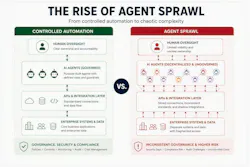
Consider an example of a global manufacturer. Procurement deploys supplier-evaluation agents. Logistics launches shipment-monitoring agents. Finance introduces invoice-review agents. HR adopts recruiting agents. The customer operations department implements customer-service agents. Every initiative solves a legitimate business problem.
But within a few years, leadership may find itself managing dozens or hundreds of agents operating across different platforms, vendors, departments and governance structures.
As a result, ownership becomes unclear, visibility declines and costs and risks begin to accumulate, creating a problem that looks increasingly similar to SaaS sprawl.
The difference is that SaaS applications generally don't make decisions. AI agents increasingly do.
An abandoned SaaS application might waste money. An abandoned AI agent may continue shaping decisions.
Who owns the agent?
One of the most overlooked governance questions is ownership and accountability.
Every AI agent should have a clearly identifiable business owner, not merely a technical administrator. Someone responsible for:
- Performance.
- Risk.
- Compliance.
- Cost management.
- Business outcomes.
An abandoned workflow can create inefficiencies. An abandoned AI agent, though, can continue recommending vendors, approving transactions, escalating customer actions, or influencing decisions long after its original owner has left the organization.
Without clear ownership, agent sprawl quickly becomes governance sprawl.
Human judgment becomes more valuable as AI autonomy grows
Microsoft's 2026 Work Trend Index found that critical thinking and quality control are becoming more important as AI adoption grows. The report also found that organizational factors such as leadership alignment, culture and operating models have more than twice the impact on AI success as individual user behavior.
5 Signs You're Developing Agent Sprawl
- No centralized inventory of agents
- Multiple business units deploying agents independently
- Duplicate capabilities and actions across departments
- Unclear ownership and accountability
- Inability to identify all systems and APIs that agents can access
Consider an example of commercial lending. An AI agent can analyze financial statements, identify risk indicators, monitor industry conditions and recommend action.
But if a lending decision influenced by AI later, for example, creates regulatory issues, accountability doesn't belong to the algorithm.
It belongs to leadership.
The same principle applies to capital allocation, cybersecurity, regulatory matters, workforce decisions and enterprise risk management.
The organizations creating the most value from AI aren't removing humans from decisions. They're redesigning where humans intervene.
The cost challenge is bigger than most leaders expect
Many organizations are about to discover that AI agents create ongoing operating expenses, not one-time expenses.
As enterprises move from AI pilots to large-scale deployments, Deloitte’s Tech Trends 2026 report identifies AI infrastructure strategy and inference economics as growing executive concerns, including how to pay for models and manage the environment required to support them.
The first AI agent often looks inexpensive. The hundredth rarely does.
Most business cases focus on model access, inference, APIs and cloud resources. They often underestimate the costs of security oversight, governance, compliance, integration maintenance and human review.
The challenge is no longer automating work. It's understanding who, or what, is shaping critical business decisions.
Consider a scenario of a company deploying agents across procurement, finance, HR and customer service. The tech costs are easy to calculate. The hard part is funding the governance and management structures needed to keep those agents operating safely and effectively.
That's why CIOs may soon need formal agent budgets, much like they manage cloud and cybersecurity spending. Instead of asking, "How much does this agent cost?" ask, "What will it cost to operate and govern this agent at scale?"
Geopolitics is now part of automation strategy
An AI agent might identify the lowest-cost supplier, but remain blind to geopolitical exposure, regulatory shifts or concentration risk.
Human leaders, however, must evaluate a broader picture, including:
- Geopolitical instability.
- Data-sovereignty requirements.
- Regulatory exposure.
- Supply-chain resilience.
- Business continuity risk.
An answer that is operationally efficient may be strategically dangerous.
Similarly, enterprises should evaluate how dependent critical workflows have become on a small number of AI providers.
Vendor lock-in is no longer just an infrastructure problem. As AI agents become embedded in business processes and decision-making, switching providers may become significantly harder.
The deeper autonomy becomes embedded in operations, the more important portability and resilience become.
Additional Resources
These resources can help you learn more about AI agents:
- “Keeping Your AI Agent in Line: Essential Security Measures for Enterprise AI Deployment” — TechEDGE
- “How To Embed Security Into Agentic AI Deployments” — TechEDGE
- “What is the current state of enterprise AI agent adoption in mid-2026?” — ampcome
- Tech Trends 2026 — Deloitte
Measure outcomes, not activity
An organization with 1,000 agents isn't necessarily outperforming one with 100. The better question is whether decision quality, cycle time and margin performance are improving.
So, focus on metrics such as:
- Decision-cycle time.
- Revenue per employee.
- Customer-resolution speed.
- Compliance performance.
- Risk reduction.
- Operating margins.
- Time-to-market.
The real leadership challenge
The new automation stack isn't just a technology architecture. It's a decision architecture.
As Microsoft notes in its research, "the job of every leader is to rearchitect work." That's the challenge facing IT leaders.
The first generation of automation focused on replacing tasks. The next generation is focused on influencing decisions. Enterprises can recover from choosing the wrong platform. But recovering from the wrong governance model is much harder.
Success doesn’t mean deploying the most AI agents. It means building the most effective balance of autonomy, accountability and human judgment.
About the Author
 Theresa Houck
 Theresa Houck
Contributor
Theresa Houck is an award-winning B2B journalist with more than 35 years of experience covering industrial markets, strategy, policy, and economic trends. As Senior Editor at EndeavorB2B, she writes about IT, OT, AI, manufacturing, industrial automation, cybersecurity, energy, data centers, healthcare, and more. In her previous role, she served for 20 years as Executive Editor of The Journal From Rockwell Automation magazine, leading editorial strategy, content development, and multimedia production including videos, webinars, eBooks, newsletters, and the award-winning podcast “Automation Chat.” She also collaborated with teams on social media strategy, sales initiatives, and new product development.
Before joining EndeavorB2B, she was an Industry Analyst at Wolters Kluwer in its human resources book publishing operation. Before that, she spent 14 years with the Fabricators & Manufacturers Association, Intl., serving as Executive Editor of four magazines in the sheet metal forming and fabricating sector, where she managed and executed editorial strategy, budgets, marketing, book publishing, and circulation operations, and negotiated vendor contracts.
Houck holds a Master of Arts in Communications from the University of Illinois Springfield and a Bachelor of Arts in English from Western Illinois University.
 Resources
Quiz
Your Competitive Edge, DeliveredStay ahead of the curve with weekly insights into emerging technologies, cybersecurity, and digital transformation. TechEDGE brings you expert perspectives, real-world applications, and the innovations driving tomorrow’s breakthroughs, so you’re always equipped to lead the next wave of change.