From Service Provider to Sustainability Partner: How to Turn an MSP Into a Measurable Impact Driver
Key Highlights
- IT infrastructure is now a major sustainability force, with data center and organization IT devices creating e-waste and energy consumption that place CIOs, CTOs and other tech leaders at the center of ESG accountability.
- Tech leaders can partner with MSPs to turn sustainability from intention into execution.
- To get the most from MSPs, outline specifics to their team and in the service level agreement (SLA) about sustainability expectations and be specific about measurable outcomes you want.
- Continuous, data-driven MSP operations enable board-level ESG reporting by turning IT activity into real-time emissions insights, cost savings and scalable sustainability gains.
- Sustainability activities and successes become quantifiable, actionable and accountable.

As an organization or data center evolves, its IT requirements also evolve. If you hire a managed service provider (MSP) to help with that growth, the first step to getting value from your MSP is to switch from a vendor relationship to a partnership. You can read about how to do this in our article, “How to Turn MSP Partnerships into Measurable Business Outcomes.”
In that partnership, your expectation is measurable outcomes. Plain and simple. And one of those is to help improve sustainability. This is important because IT infrastructure is a major energy consumer, placing tech leaders at the center of enterprise environmental-impact conversations.
For example, according to consumer advocate firm PIRG, the United States generates about 7-10 million metric tons of electronic waste (e-waste) annually. And data centers and IT equipment, such as servers, laptops, monitors and other components, produce 11 billion pounds of global e-waste.
Because VPs of IT, CISOs, CTOs, CIOs and other tech leaders sit at the intersection of technology, data and operations, they’re in a unique position to turn sustainability into a measurable, actionable and scalable advantage.
So, MSPs must help you achieve your goals while providing you with auditable data, asset life cycle management, energy optimization and measurable metrics.
MSPs can help move sustainability from intention to execution by combining:
- Data measurement and reporting.
- Optimization of efficiency and cost reduction.
- Infrastructure choices, such as cloud and data center optimization.
- Continuous improvement.
When that happens, sustainability activities and successes become quantifiable, actionable and accountable.
What exactly are MSP measurable impacts?
In the big picture, MSPs should use a combination of AI-driven monitoring, predictive maintenance and cloud-native architectures to help you reach sustainability goals.
According to a 2024 IDC study cited by Perma Technologies, enterprises using managed services for infrastructure optimization achieve 30-40% lower energy costs and 20% fewer hardware replacements, which supports both sustainability and financial efficiency.
How managed services drive green IT
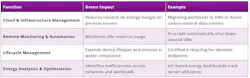
A 2024 study by IDC found that enterprises using managed services for infrastructure optimization achieve 30-40% lower energy costs and 20% fewer hardware replacements. Source: Perma Technologies
So, how can MSPs deliver measurable impact? Here are specific ways.
1. Carbon measurement, attribution and environmental, social and governance (ESG) reporting. One of the biggest challenges for IT leaders is simply knowing where emissions come from. MSPs can help solve this by implementing tools and data pipelines that measure carbon at a granular level, allowing you to perform operations such as:
- Track emissions across the cloud, end points and data centers.
- Attribute carbon to applications, teams or business units.
- Provide audit-ready Environmental, Social, and Governance (ESG) dashboards and reports.
For example, platforms used by MSPs can measure and report emissions across Scope 1 (direct emissions from owned/controlled sources); Scope 2 (indirect emissions from purchased energy); and Scope 3 includes all other upstream/downstream value chain emissions.
The firms can also help tech leaders to measure, analyze, report and act on sustainability initiatives, as well as achieve measurable impacts such as:
- Track cloud carbon footprint, with measurable impact such as CO₂ per workload/app.
- Optimize workloads.
- Generate ESG reports for regulators and investors, with measurable impact, such as emissions by business unit.
Don’t overlook the governance function here. It's important for you to embed sustainability into your governance, and that requires structure, visibility and accountability. Many organizations are incorporating sustainability into their governance cadence by including:
- Operational reviews that include energy usage and efficiency trends.
- Quarterly business reviews that assess progress against ESG goals.
- Joint roadmaps focused on reducing environmental impact over time.
Successful integration of sustainable IT practices requires cross-functional leadership that coordinates IT, finance and operations to tie circular KPIs to cost, risk and ESG outcomes.
2. Cloud and workload optimization — lower emissions per compute unit. MSPs can help enterprises reduce emissions by running IT workloads more efficiently with tactics such as:
- Moving workloads to lower-carbon cloud regions.
- Rightsizing compute resources.
- Scheduling workloads based on energy intensity.
Measurable impact includes carbon per compute hour, energy consumption per workload, and percent of reduction from baseline.
3. Data centers, energy-efficient infrastructure and data-center management. MSPs can heavily influence sustainability in these ways:
- Shift clients to energy-efficient or renewable-powered data centers.
- Deploy advanced cooling (e.g., liquid cooling).
- Continuously optimize energy usage.
Managed data-center environments focus on efficiency and climate-neutral operations, with measurable impact such as:
- Power usage effectiveness (PUE).
- kWh consumption per workload.
- Percent of renewable energy usage.
4. Hardware life cycle management and e-waste reduction. MSPs help reduce environmental impact by extending and optimizing hardware usage, including:
- Device life cycle management, such as repair, reuse and recycle.
- “As-a-service” models that reduce overprovisioning.
- Reduced refresh cycles, which lead to less e-waste.
This can provide measurable impact results, such as:
- Reduction in e-waste volume.
- Extended device lifespan.
- Reduction in CapEx investments.
5. Real-time monitoring and continuous optimization. Unlike one-time consulting, an MSP partnership can provide continuous oversight of IT environments, including:
- Monitor energy and emissions in real time.
- Automatically optimize performance versus carbon tradeoffs.
- Provide ongoing benchmarking and improvement.
Continuous management provides measurable impact, including:
- Continuous emissions tracking.
- Month-over-month carbon reduction.
- Service level agreement-based sustainability metrics.
MSPs can help enterprises reduce emissions by running IT workloads more efficiently.
6. Enabling low-carbon operating models like remote work and digitalization. MSPs can also help reduce indirect emissions by helping IT change how work happens:
- Enable secure remote/hybrid work environments.
- Reduce commuting and office energy usage.
- Digitize workflows to eliminate paper and physical processes.
Remote work infrastructure can cut emissions tied to commuting and office space and provide office energy savings and Scope 3 reductions.
7. Standardization and scaling sustainability across clients. MSPs can help “industrialize” sustainability by embedding it into repeatable services that include:
- Prebuilt dashboards and emission factor libraries.
- Standardized sustainability frameworks.
- Scalable delivery across multiple clients.
Measurable impact can include:
- Time to deploy ESG reporting.
- Percentage of IT environment covered by sustainability metrics.
- Loss-portfolio benchmarking.
Why even care?
Sustainability efforts live or die by accurate data, and MSPs sit at a critical control point with visibility into infrastructure performance, cloud usage and system behavior. When shared in a true partnership with IT, that insight allows smarter, more sustainable IT decisions across the enterprise.
And that’s what boards of directors, executives, regulators and customers expect.
Like what you're reading? Subscribe to our free weekly newsletter.
About the Author
 Theresa Houck
 Theresa Houck
Contributor
Theresa Houck is an award-winning B2B journalist with more than 35 years of experience covering industrial markets, strategy, policy, and economic trends. As Senior Editor at EndeavorB2B, she writes about IT, OT, AI, manufacturing, industrial automation, cybersecurity, energy, data centers, healthcare, and more. In her previous role, she served for 20 years as Executive Editor of The Journal From Rockwell Automation magazine, leading editorial strategy, content development, and multimedia production including videos, webinars, eBooks, newsletters, and the award-winning podcast “Automation Chat.” She also collaborated with teams on social media strategy, sales initiatives, and new product development.
Before joining EndeavorB2B, she was an Industry Analyst at Wolters Kluwer in its human resources book publishing operation. Before that, she spent 14 years with the Fabricators & Manufacturers Association, Intl., serving as Executive Editor of four magazines in the sheet metal forming and fabricating sector, where she managed and executed editorial strategy, budgets, marketing, book publishing, and circulation operations, and negotiated vendor contracts.
Houck holds a Master of Arts in Communications from the University of Illinois Springfield and a Bachelor of Arts in English from Western Illinois University.
 Resources
Quiz
Your Competitive Edge, DeliveredStay ahead of the curve with weekly insights into emerging technologies, cybersecurity, and digital transformation. TechEDGE brings you expert perspectives, real-world applications, and the innovations driving tomorrow’s breakthroughs, so you’re always equipped to lead the next wave of change.