How to Turn MSP Partnerships into Measurable Business Outcomes
Key Highlights
- The true return on a managed service provider comes from how the partnership is structured and evolved, not just from the initial vendor choice.
- The key to unlocking strategic value is to shift from outputs to impact, moving beyond service level agreements and ticket metrics to business-aligned results.
- Treating the MSP as an embedded extension of the IT organization through shared goals, operating models and governance drives greater efficiency and innovation.
- High-performing partnerships are dynamic, incentivized for innovation and built on trust, allowing organizations to adapt, scale and sustain competitive advantage.

Selecting a managed service provider (MSP) is a big deal for CTOs and the IT team, who invest considerable time in vendor evaluation and onboarding to find the right match. But finally selecting the MSP isn’t the moment the IT team gets value from the partnership.
In fact, many tech leaders only get minimal benefits because they let the relationship settle into a steady-state service model defined by tickets, service level agreements (SLAs) and periodic reviews. As a result, the organization gets competence from the MSP, but not a competitive advantage.
That’s an enormous missed opportunity for CTOs and other tech leaders who are under pressure to maintain resilience, add more value to the enterprise and contribute to profitability.
The key is to go beyond managing and use them as strategic extensions of their teams. That’s because the true return on an MSP is determined by how the relationship evolves over time.
“Good Enough” Isn’t Good Enough
Most MSPs deliver what they promise: systems stay up, incidents are resolved and environments remain stable. On paper, the relationship works.
But stability alone doesn’t move the business forward.
In an era defined by cloud proliferation, rising cyber risk and relentless demand for digital innovation, CTOs need partners who help them anticipate change, improve efficiencies and achieve the organization’s goals and outcomes.
The challenge is that MSPs won’t naturally operate this way unless the relationship is designed to demand it. And the shift begins with mindset. Digital leaders need to stop thinking of MSPs as external vendors and start treating them as integrated partners.
This doesn’t mean giving up control; it means expanding influence.
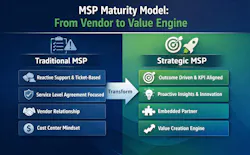
When a Managed Service Provider is embedded into strategic planning, aligned to business priorities and accountable for outcomes, it becomes a mechanism for growth.
When an MSP is embedded into strategic planning, aligned to business priorities and accountable for outcomes and not just outputs, it becomes a mechanism for growth. Then internal teams can focus on high-value initiatives while the MSP contributes to insight.
And that’s when the relationship becomes a strategic differentiator.
Align to Outcomes That Matter
One of the most common constraints in MSP relationships is the overreliance on traditional metrics. SLAs, ticket volumes and response times are essential, but they’re backward-looking indicators of activity, not forward-looking indicators of impact.
CTOs and other tech leaders must be able to act as problem-solvers and translators of complex issues for the rest of the organization. So, shift the conversation to business impact and redefine success of the partnership in terms that executives understand, such as:
- How much faster are we delivering new capabilities?
- How effectively are we reducing risk across our environment?
- Where are we gaining efficiency that can be reinvested into innovation?
- How more effectively are we improving sustainability, cost control and resiliency?
Outcome Metrics That Matter in an MSP Relationship
Move beyond service level agreements (SLAs) to track outcomes to which MSPs contributed, including:
- Improved time-to-market enabled by new capabilities
- Percent reduction in security risk exposure across the enterprise
- Cost savings and efficiency gains are reinvested in innovation
- Efficiency gains driven by automation
- Measurable improvements in sustainability, cost control, scalability and resiliency
- Improvements in workforce skills and efficiency
- Improvements in customer experience
Also:
- Tie services to KPIs such as revenue enablement, customer experience or time-to-market.
- Define success in terms of outcomes, such as faster deployments, reduced risk and improve resilience.
- Revisit these goals quarterly as priorities evolve.
When these become benchmarks, reporting becomes insight and accountability becomes shared.
Build a Joint Operating Model
Even with aligned goals and accountability, many MSP relationships underperform because they are structurally disconnected. Internal teams and the MSP operate in parallel rather than in sync.
It’s important to establish a joint operating model in which workflows, tools and decision-making processes are interconnected — with responsibilities clearly defined and collaboration built into the system.
This includes shared roadmaps that tie MSP activities directly to business priorities; integrated incident and change management processes; and clear escalation paths that emphasize resolution over ownership disputes.
No operating model succeeds without trust. Strong relationships across teams drive knowledge sharing, and IT leaders should recognize MSP contributions as part of overall success. This will blur the line between internal and external teams into a unified IT capability.
Turn Governance into a Growth Tool
And then there’s governance. It’s often treated as a necessary discipline that’s structured, periodic and retrospective. But in high-performing MSP relationships, governance becomes a tool for continuous improvement and an area where MSPs can deliver exceptional value.
This is partly because MSPs have multiple clients and environments, providing them with extensive experience and insight into what other organizations are doing that IT internal teams rarely have. This can give CTOs access to patterns, benchmarks and innovations that would otherwise remain out of reach.
Questions to Ask Your MSP Quarterly:
- What risks do you see that we don’t see?
- Where can we automate or eliminate work?
- What are other organizations doing that we should consider?
- How are you helping us achieve our business goals?
And, a best practice is to establish a governance cadence, because strong relationships run on structured, consistent communication. For example, these can include:
- Weekly/biweekly operational check-ins
- Monthly performance reviews on factors such as metrics, incidents and improvements
- Quarterly business reviews on issues such as strategy, innovation and roadmap alignment
Reviews become forums for identifying emerging risks, reprioritizing initiatives and introducing new ideas, from automation opportunities to cost optimization strategies to security enhancements.
Create Incentives for Innovation
Most MSP contracts are designed to reward consistency, such as meeting the SLA, controlling costs and avoiding disruption, etc. These are important, but they also unintentionally reinforce a reactive posture. If IT leaders want innovation, they need to incentivize it. Make sure the MSP benefits from helping the organization improve.
This can take many forms: outcome-based incentives, gain-sharing models or dedicated innovation backlogs with measurable targets. The goal is to embed ways to reward, such as:
- Automation that reduces manual effort and cost
- New solutions that improve resilience or scalability
- Proactive identification of security or compliance gaps
- Recommendations that drive measurable business impact
These incentives will spur MSPs to identify opportunities that benefit both parties.
Design for Evolution
It’s possible the most important — and most overlooked — aspect of MSP partnership success is adaptability. After all, business priorities shift and technologies evolve. What an organization needs from its MSP now won’t be what it needs several years from now.
Smart CTOs regularly reassess what should be outsourced, what should be retained in-house and where new capabilities are needed, including factors such as:
- Scope of services: What should expand, contract or move in-house?
- Capability gaps that the MSP can help fill
- Opportunities to co-develop new solutions or services
- Alignment with long-term strategic goals
The goal is to continuously refine the partnership.
Brilliance of the Partnership
With demands on tech leaders continuing to expand, no organization can do everything alone. The real opportunity of an MSP strategic partnership is to accelerate transformation, enhance resilience, broaden IT capabilities, improve customer experience through enhanced IT performance, mitigate technological and security risks, and increase competitive advantage.
Like what you're reading? Subscribe to get TechEDGE delivered to your inbox each week.
About the Author
 Theresa Houck
 Theresa Houck
Contributor
Theresa Houck is an award-winning B2B journalist with more than 35 years of experience covering industrial markets, strategy, policy, and economic trends. As Senior Editor at EndeavorB2B, she writes about IT, OT, AI, manufacturing, industrial automation, cybersecurity, energy, data centers, healthcare, and more. In her previous role, she served for 20 years as Executive Editor of The Journal From Rockwell Automation magazine, leading editorial strategy, content development, and multimedia production including videos, webinars, eBooks, newsletters, and the award-winning podcast “Automation Chat.” She also collaborated with teams on social media strategy, sales initiatives, and new product development.
Before joining EndeavorB2B, she was an Industry Analyst at Wolters Kluwer in its human resources book publishing operation. Before that, she spent 14 years with the Fabricators & Manufacturers Association, Intl., serving as Executive Editor of four magazines in the sheet metal forming and fabricating sector, where she managed and executed editorial strategy, budgets, marketing, book publishing, and circulation operations, and negotiated vendor contracts.
Houck holds a Master of Arts in Communications from the University of Illinois Springfield and a Bachelor of Arts in English from Western Illinois University.
 Resources
Quiz
Your Competitive Edge, DeliveredStay ahead of the curve with weekly insights into emerging technologies, cybersecurity, and digital transformation. TechEDGE brings you expert perspectives, real-world applications, and the innovations driving tomorrow’s breakthroughs, so you’re always equipped to lead the next wave of change.