What Is Frontier AI, and Why Should IT Leaders Care?
Key Highlights
- Frontier AI is becoming a core enterprise technology, shaping architecture, security, governance, budgets, operations and IT strategy.
- Frontier AI expands automation by enabling systems to reason, generate code and execute complex business workflows.
- Scaling frontier AI introduces new architecture, cost, security, compliance and governance challenges for technology leaders.
- Enterprises that deploy frontier AI effectively may gain competitive advantages while managing rising infrastructure and geopolitical risks.

Frontier AI is pushing enterprise technology beyond traditional automation and into systems capable of reasoning, planning, coding and performing across business processes. Enterprises are using them as the foundation for AI agents, enterprise assistants, software development tools, analytics platforms and workflow automation systems.
That matters to IT pros because frontier AI isn’t just another software tool. It's becoming a new enterprise computing layer that influences application architecture, infrastructure planning, cybersecurity, governance, workforce strategy and long-term technology investment decisions.
So what is frontier AI? Frontier AI models are large-scale systems at the cutting edge, or “frontier,” of capabilities like reasoning, multimodal understanding, code generation and autonomous task execution. Unlike traditional AI tools built for a single narrow purpose, frontier models can be applied across a range of enterprise functions.
In fact, the models push the limits of what machines can do, and the definition changes constantly as technology improves.
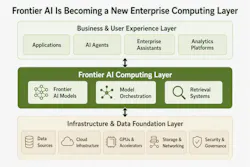
Modern AI agents are built as systems that integrate both frontier and specialized models. This architectural approach ensures organizations remain "always at the frontier on the one hand, always customized on the other hand," as Nvidia describes it, while maintaining operational efficiency.
6 key areas frontier AI elevates IT decisions
Many technology trends improve existing processes. Frontier AI has the potential to reshape them.
For IT leaders, frontier AI has the potential to become a foundational enterprise technology that affects nearly every aspect of IT, from infrastructure and security to budgets, governance and business operations. The question is how quickly organizations can adapt to its opportunities and risks.
Let’s examine six areas where frontier impacts AI enterprise decision-making for business outcomes, architecture, budgets, risk and more
1. It changes and expands what's possible to automate. Traditional automation follows predefined rules. Frontier AI can reason through ambiguous situations, synthesize information from multiple sources, generate content, write code and increasingly execute multi-step workflows. This expands the range of business processes that can be partially or fully automated.
That opens opportunities to automate work that was previously considered too complex, unpredictable or knowledge-intensive. For IT leaders, the value is the possibility of reducing costs, accelerating decision-making and improving employee productivity.
2. It’s reshaping enterprise architecture. Organizations are adding new architectural components such as AI agents, model orchestration layers, retrieval systems and AI governance platforms. Many enterprises are moving toward a "system of models" approach that combines frontier models with smaller, specialized models.
For CTOs, the challenge isn't simply deploying AI — it's building an architecture that remains scalable, secure and manageable as AI capabilities continue to evolve.
4 Key Characteristics of Frontier AI
- Massive Scale: They’re trained on huge amounts of data using extreme computing power, often exceeding 10²⁶ floating-point operations (FLOPs).
- Multimodal Abilities: They process text, images, audio and video at the same time inside a single unified system.
- Emergent Behaviors: They display unexpected skills — such as complex multi-step reasoning, coding and planning — that developers didn’t explicitly hardcode.
- Autonomous Action: They can act as digital agents, executing long workflows with minimal human oversight.
Sources: Palo Alto Networks, Cisco.
3. It is reshaping enterprise architecture. The rise of frontier AI introduces a new architectural layer that sits across applications, data sources, workflows and user experiences. Enterprises are adding new architectural components like AI agents, model orchestration layers, retrieval systems and AI governance platforms.
Some are moving toward a "system of models" approach that combines frontier models with smaller, specialized models.
For CTOs, the challenge is building an architecture that remains scalable, secure and manageable as AI capabilities continue to evolve.
4. It introduces new budget priorities. Many organizations began with small AI pilots, but scaling exposed costs that weren’t apparent during experimentation. Frontier AI often requires investments in cloud services, GPUs, data infrastructure, security, monitoring and governance. This turns AI into a long-term operational commitment.
The budgeting challenge is that AI costs don't always scale predictably. Successful deployment can dramatically increase infrastructure consumption, governance requirements and operational expenses.
Just as cloud spending created unexpected budget growth a decade ago, AI consumption has the potential to expand much faster than initial forecasts.
(To learn more about budgeting for all the hidden AI, governance and compliance costs, see our TechEDGE article, “Is Your Strategic Planning Outdated? 9 Assumptions CIOs Can’t Afford to Make.”)
5. It creates new enterprise risk. As AI gains access to enterprise data and processes, concerns are growing about privacy, security, intellectual property, compliance, hallucinations and autonomous decision-making. Regulators and industry groups are responding with increased scrutiny and governance requirements.
The international Organisation for Economic Co-operation and Development (OECD) and other policymakers have emphasized the need for stronger evaluation, governance and safety controls for advanced AI systems — frontier AI — because of the new risks they can introduce.
For CISOs, CSOs and other risk leaders, AI governance is quickly becoming as important as cybersecurity governance.
Frontier AI is making AI leadership a shared responsibility across the technology executive team.
6. It may determine future competitiveness. Many executives now view frontier AI as a strategic capability, similar to cloud computing or the internet was in previous eras. Enterprises that effectively deploy AI may gain advantages in productivity, software development, customer experience, analytics and efficiency, while slower adopters risk falling behind.
How do geopolitics affect frontier AI?
Frontier AI isn’t only about technology. It’s tied to global competition for compute capacity, semiconductors, energy, cloud infrastructure and AI talent.
So, companies deploying frontier AI now depend on a global ecosystem that includes cloud providers, AI model developers, semiconductor manufacturers and infrastructure vendors. (See our TechEDGE article, “Why CIOs Need to Build Geopolitical Risk Into Technology Strategy.”) And that means geopolitical events, trade restrictions, supply chain disruptions and competition for advanced chips can affect enterprise AI strategies and costs.
For CIOs and CTOs, AI planning is even more connected to broader questions about where vendors are located, infrastructure dependency and long-term resilience.
How does frontier AI shift IT leadership roles?
Frontier AI is blurring the boundaries of traditional technology leadership. An AI agent that accesses enterprise data, makes recommendations and takes actions can simultaneously affect architecture, security, compliance, operations, and business strategy. As a result, AI is becoming one of the few technologies that require ongoing collaboration across almost every technology leadership role.
Additional Resources
These resources may help you learn more about frontier AI and related planning effects.
- Cisco Overview of Frontier Models - Cisco
- What Are Frontier Models? – Nvidia
- Understanding Frontier AI: Definitions, Models, and Business Impact – Crowdstrike
- "Why CIOs Need to Build Geopolitical Risk Into Technology Strategy” – TechEDGE
- “Is Your Strategic Planning Outdated? 9 Assumptions CIOs Can’t Afford to Make” – TechEDGE
For CIOs and CTOs, the impact is on strategic planning and architecture. For CISOs and CSOs, it is governance, security and risk management. For COOs and VPs of IT, it is operational transformation.
Ultimately, frontier AI is making AI leadership a shared responsibility across the technology executive team rather than a specialized function.
Next step in a new era
The significance of frontier AI isn't simply that the models are getting smarter. It’s making AI become a foundational IT enterprise platform that simultaneously affects architecture, cybersecurity, budgets, workforce planning, governance and business operations.
For technology leaders, frontier AI is more than an innovation project sitting on the edge of the organization. It's becoming part of the core IT infrastructure that will shape how enterprises operate, compete and grow.
About the Author
 Theresa Houck
 Theresa Houck
Contributor
Theresa Houck is an award-winning B2B journalist with more than 35 years of experience covering industrial markets, strategy, policy, and economic trends. As Senior Editor at EndeavorB2B, she writes about IT, OT, AI, manufacturing, industrial automation, cybersecurity, energy, data centers, healthcare, and more. In her previous role, she served for 20 years as Executive Editor of The Journal From Rockwell Automation magazine, leading editorial strategy, content development, and multimedia production including videos, webinars, eBooks, newsletters, and the award-winning podcast “Automation Chat.” She also collaborated with teams on social media strategy, sales initiatives, and new product development.
Before joining EndeavorB2B, she was an Industry Analyst at Wolters Kluwer in its human resources book publishing operation. Before that, she spent 14 years with the Fabricators & Manufacturers Association, Intl., serving as Executive Editor of four magazines in the sheet metal forming and fabricating sector, where she managed and executed editorial strategy, budgets, marketing, book publishing, and circulation operations, and negotiated vendor contracts.
Houck holds a Master of Arts in Communications from the University of Illinois Springfield and a Bachelor of Arts in English from Western Illinois University.
 Resources
Quiz
Your Competitive Edge, DeliveredStay ahead of the curve with weekly insights into emerging technologies, cybersecurity, and digital transformation. TechEDGE brings you expert perspectives, real-world applications, and the innovations driving tomorrow’s breakthroughs, so you’re always equipped to lead the next wave of change.