Governance Playbook: 8 Steps for Building an IT Device and Hardware Management Policy
Key Highlights
- The most effective device and hardware policies start with business objectives, not hardware specifications.
- Policies are governance frameworks that align technology assets with organizational goals.
- Device and hardware policies become strategic tools that support every major IT initiative, from AI adoption and cybersecurity modernization to workforce transformation and efficiency.
- Life cycle management is the foundation of effective governance.
- Security, accountability and visibility must be built into a policy, or even well-written policies can fail.

Nearly every digital initiative depends on IT devices and hardware, but many enterprises still treat endpoint policies as documentation instead of strategic governance frameworks. We examine how to develop effective asset management policies and use them as strategic tools that support major IT initiatives.
The key is to understand that the most effective policies start with business objectives, not hardware specifications.
So, here are nine steps needed to develop an effective device and hardware policy.
1. Where should you start? With business goals.
Define what the business needs.
Many IT leaders begin policy discussions by asking which devices employees should use, but that’s the wrong starting point.
A stronger approach is to first identify which business outcomes the policy must support. To determine that from a top-level executive view, ask questions such as:
- What productivity outcomes are we trying to achieve?
- What security risks must we reduce?
- How will employees work — in office, remotely or both?
- What compliance obligations apply?
- What cost-management targets must be met?
- What user experience expectations exist?
Deeper framework for identifying business objectives. IT leaders can use a framework of strategic questions (see Table 1) to help determine the policy implications of business objectives. Those questions can help translate business goals into device and hardware management requirements.
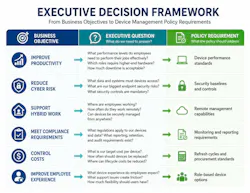
Ask questions such as:
- What performance levels do employees need to perform their jobs effectively?
- Which roles require higher-end hardware?
- How much downtime is acceptable?
- What data and systems must devices access?
- What are our biggest endpoint security risks?
- What security controls are mandatory?
- Where are employees working?
- How often do they work remotely?
- Can devices and hardware be securely managed from anywhere?
- What regulations apply to our devices, hardware and data?
- What reporting, retention and audit requirements exist?
- What is our target cost per device?
- How often should devices and hardware be replaced?
- Where can life cycle costs be reduced?
- What device or hardware experience do employees expect?
- What support issues create friction?
- How much flexibility should users have?
An endpoint infrastructure policy should answer the question, “How should we manage technology assets to support organizational goals?” and not, “Which laptop models are approved?”
What to do next. Once business objectives are defined, the next step is translating those goals into operational practices. The most effective way to do that is through life cycle management, which establishes how devices are acquired, deployed, supported, refreshed and retired throughout their useful life.
2. Take a life cycle approach to device and hardware policy
Manage assets throughout their life cycle.
Many organizations invest heavily in procurement and deployment but devote far less attention to maintenance, upgrades and retirement. The result is inconsistent asset management, security gaps and higher operational costs.
Life cycle checklist. It’s important to consider the life cycle of your assets. Here’s a checklist of what a complete policy should address:
✓ Acquisitions
• Approved vendors
• Purchasing standards
• Hardware specifications
• Budget approvals
✓ Deployment
• Provisioning procedures
• Security configuration
• Software installation
• User onboarding
✓ Operations
• Patch management
• Monitoring
• Performance management
• Technical support
✓ Refresh
• Replacement schedules
• Upgrade criteria
• Warranty management
✓ Retirement
• Data sanitization
• Asset recovery
• Recycling procedures
• Secure disposal
What to do next. Review the enterprise’s current policy and identify which life cycle stages receive little or no governance. Most IT leaders discover gaps around refresh planning and device retirement.
Of course, a life cycle approach improves consistency and cost control, but it also creates a foundation for security. Every stage — from procurement through retirement — introduces potential risks that must be governed and monitored.
3. How should security be incorporated into device and hardware policies?
Secure every life cycle stage.
Security requirements should be embedded throughout every life cycle stage.
And asset management and cybersecurity can’t operate as separate disciplines. They’re inseparable. So, it’s important to make security the foundation of the policy.
The National Institute of Standards and Technology (NIST) emphasizes securing mobile devices throughout their entire life cycle rather than treating endpoint security as a standalone function. See NIST SP 800-124 Rev. 2.
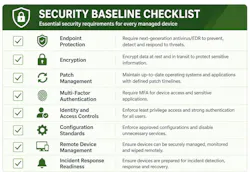
Security baseline checklist. Every device and hardware policy should define factors such as (see Table 2):
✓ Endpoint protection requirements.
✓ Encryption standards.
✓ Multi-factor authentication requirements.
✓ Patch management timelines.
✓ Identity and access controls.
✓ Configuration management standards.
✓ Remote management capabilities.
✓ Incident response procedures.
Where AI plays a role. AI increasingly supports:
- Automated threat detection.
- Device anomaly monitoring.
- Vulnerability prioritization.
- Predictive maintenance.
- Automated compliance reporting.
However, AI should augment security operations, not replace foundational controls.
4. Define roles, responsibilities and governance: Who should own device management?
Assign accountability.
Many device and hardware programs fail because accountability is fragmented.
Typically, procurement buys devices. IT deploys them. Security monitors them. HR manages onboarding and offboarding. When responsibilities overlap without clear ownership, governance breaks down.
This is increasingly important because cybersecurity governance is now viewed as a component of broader enterprise risk management rather than a standalone IT function. Recent updates to NIST's IR 8286 series place greater emphasis on governance, executive oversight and aligning cybersecurity decisions with organizational objectives and enterprise risk management.
Effective governance requires more than assigning tasks. It requires clearly defining who is accountable for decisions, who has authority to approve exceptions, and who is responsible for monitoring compliance throughout the device life cycle.
Without that structure, organizations often experience:
- Inconsistent enforcement of device standards.
- Delayed patching and remediation.
- Unmanaged or unauthorized devices.
- Gaps during employee onboarding and offboarding.
- Confusion over ownership of security incidents.
- Higher audit and compliance risk.
One useful way to think about governance is to separate ownership from execution. Governance establishes direction, accountability and oversight, while management teams execute the day-to-day activities required to support those objectives (see Table 3).
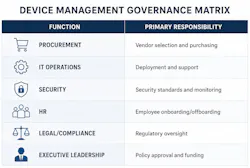
This distinction is emphasized in IT governance frameworks such as ISO/IEC 38500, which stresses clear decision rights and accountability between governing bodies and operational management.
A governance matrix should clearly identify who:
- Approves device standards.
- Owns endpoint security requirements.
- Authorizes exceptions.
- Oversees life cycle management.
- Monitors compliance.
- Reports performance metrics to executive leadership.
It’s important to clarify these roles in a governance matrix:
- IT operations responsibilities.
- Security team responsibilities.
- Procurement roles.
- HR involvement for onboarding and offboarding.
- Executive oversight.
Key question to ask. For every stage of the life cycle, can anyone clearly answer the question, “Who is accountable?” If not, governance risk exists, and even strong policies can fail.
5. Balance standardization with business flexibility: How much is enough?
Create controlled flexibility supported by governance.
Standardization reduces complexity, support costs and security risk. But excessive standardization can hinder productivity. Developers, engineers, executives, frontline workers and specialized business units often have unique requirements.
So, to create a practical policy approach, create:
- Standard device profiles.
- General employee
- Manager
- Executive
- Frontline worker
- Exception process.
- Business justification
- Security review
- Cost assessment
- Approval workflow
6. Prioritize visibility and asset intelligence
Gain visibility into performance.
IT leaders can’t manage what they can’t see.
Visibility is a critical component of endpoint management because it supports security, compliance, and operational planning.
Visibility checklist. IT leaders can use this visibility checklist and maintain:
✓ Real-time asset inventories.
✓ Device ownership records.
✓ Configuration visibility.
✓ Software inventories.
✓ Life cycle status tracking.
✓ Utilization reporting.
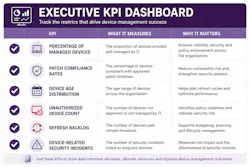
Executive KPI dashboard. Important KPIs to track include (see Table 4):
- Percentage of managed devices.
- Patch compliance rates.
- Device age distribution.
- Unauthorized device count.
- Refresh backlog.
- Device-related security incidents.
Policies should create organizational visibility — not merely administrative control.
Visibility also helps organizations prepare for change. IT leaders who maintain accurate inventories, life cycle data and performance metrics are better positioned to evaluate new device categories and workforce models as they emerge.
7. Plan for changing work models and emerging device types
Adapt to changing technology.
Visibility into today's environment is important, but effective policies must also prepare organizations for tomorrow's technology landscape.
As device ecosystems expand and workforce models evolve, IT leaders need governance frameworks that can accommodate new technologies without requiring a complete policy rewrite every few years.
Device and hardware environments are evolving rapidly, so policies should account for:
- AI-enabled PCs.
- Edge computing devices.
- IoT endpoints.
- Contractor-owned devices.
- Bring your own device (BYOD) programs.
- Distributed workforces.
Rigid policies often become obsolete before the next refresh cycle.
Future-readiness framework. Instead of writing rules for specific devices, define decision criteria such as:
- Security requirements.
- Data sensitivity.
- Management capability.
- User impact.
- Compliance implications.
- Supportability.
This approach allows organizations to evaluate emerging technologies consistently while maintaining governance, security and operational standards across the device life cycle.
8. Review and update policies regularly
Continuously review and improve.
Many enterprises create device policies once and revisit them only after an incident.
That approach creates technical debt or security debt, or what’s referred to as “governance debt” — the accumulated backlog of overlooked policies, undocumented ownership, and missing access controls that occur when IT leaders prioritize deployment speed over structural oversight.
Many device and hardware programs fail because accountability is fragmented.
Treat policy updates as part of strategic planning rather than administrative maintenance.
Annual policy review checklist. To conduct a regular review, evaluate factors such as:
✓ Security incidents and lessons learned.
✓ Regulatory changes.
✓ New device categories.
✓ Technology refresh plans.
✓ Vendor changes.
✓ AI and automation capabilities.
✓ Workforce model changes.
What to do next. Schedule an annual executive review involving:
- IT operations.
- Security.
- Procurement.
- HR.
- Compliance.
- Business stakeholders.
Device and hardware policies are really governance policies
Endpoint infrastructure management policies aren’t primarily about laptops, smartphones or other endpoints. They’re governance frameworks that help enterprises manage risk, improve security, support productivity, maintain compliance and control costs.
For CIOs, CTOs, CISOs, VPs of IT and COOs, the most effective policies focus on five areas:
- Business outcomes
- Life cycle management
- Security by design
- Clear accountability
- Continuous adaptation
When executed well, device and hardware policies become strategic tools that support every major IT initiative — from AI adoption and cybersecurity modernization to workforce transformation and operational efficiency — instead of operational documents that sit unused on a shelf.
About the Author
 Theresa Houck
 Theresa Houck
Contributor
Theresa Houck is an award-winning B2B journalist with more than 35 years of experience covering industrial markets, strategy, policy, and economic trends. As Senior Editor at EndeavorB2B, she writes about IT, OT, AI, manufacturing, industrial automation, cybersecurity, energy, data centers, healthcare, and more. In her previous role, she served for 20 years as Executive Editor of The Journal From Rockwell Automation magazine, leading editorial strategy, content development, and multimedia production including videos, webinars, eBooks, newsletters, and the award-winning podcast “Automation Chat.” She also collaborated with teams on social media strategy, sales initiatives, and new product development.
Before joining EndeavorB2B, she was an Industry Analyst at Wolters Kluwer in its human resources book publishing operation. Before that, she spent 14 years with the Fabricators & Manufacturers Association, Intl., serving as Executive Editor of four magazines in the sheet metal forming and fabricating sector, where she managed and executed editorial strategy, budgets, marketing, book publishing, and circulation operations, and negotiated vendor contracts.
Houck holds a Master of Arts in Communications from the University of Illinois Springfield and a Bachelor of Arts in English from Western Illinois University.
 Resources
Quiz
Your Competitive Edge, DeliveredStay ahead of the curve with weekly insights into emerging technologies, cybersecurity, and digital transformation. TechEDGE brings you expert perspectives, real-world applications, and the innovations driving tomorrow’s breakthroughs, so you’re always equipped to lead the next wave of change.