Governance-First AI in the Supply Chain + What Cyber Insurance Really Covers
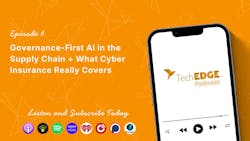




In this episode of TechEDGE, we explore how organizations are moving from experimental AI adoption to governed, enterprise-wide execution—and why cyber insurance is becoming a core pillar of modern risk strategy, not just a safety net.
From a real-world case study inside Avnet’s global supply chain to a practical breakdown of what cyber insurance actually covers, this episode gives IT leaders clear guidance on managing risk, scale, and accountability in an increasingly AI-driven environment.
Case Study: Inside Avnet’s AI Playbook—Governance-First Innovation in a Global Supply Chain
As global supply chains grow more complex and data-heavy, AI has become essential for maintaining resilience, accuracy, and speed. In this article, Avnet CIO Max Chan shares how the company embedded a governance-first AI framework directly into the workflows that keep its global operations moving.
Rather than treating AI as a standalone initiative, Avnet integrated it into inventory visibility, forecasting, inspections, technical support, and engineering design—while prioritizing training, transparency, and change management.
Key themes include:
- Why governance must come before scale in enterprise AI programs
- How AI improves forecast accuracy, inventory turnover, and risk mitigation
- Using AI for inspections, technical support, and engineering design assistance
- Preventative inventory management to reduce aged stock and forecasting errors
- Measuring AI success through operational, efficiency, and risk metrics
- Embedding AI into existing tools to reduce friction and speed adoption
- Why people—not technology—remain central to AI transformation
The article shows how disciplined governance, clean data, and employee empowerment allow AI to enhance decision-making without disrupting trusted workflows.
What Is Cyber Insurance—and Does Your Business Need It?
As cyber threats grow more frequent, automated, and expensive, many organizations are discovering that traditional insurance coverage doesn’t apply to digital incidents. This article explains what cyber insurance actually covers—and why it’s increasingly viewed as a strategic component of enterprise risk management.
Drawing on industry reports and expert insight, the piece outlines how cyber insurance supports recovery after incidents such as ransomware, data breaches, phishing attacks, and system outages.
Key takeaways include:
- What cyber insurance covers—and what it typically excludes
- The difference between first-party and third-party coverage
- Why general liability insurance doesn’t apply to cyber incidents
- Average costs of cyber insurance and what drives premiums
- How cyber insurance complements—not replaces—security controls
- Steps organizations can take to reduce premiums, including MFA, training, backups, and patching
- Why cyber insurance is becoming essential for resilience and business continuity
The article reinforces that cyber insurance doesn’t prevent attacks—but it helps organizations recover faster and manage the financial and operational impact when incidents occur.
Why It Matters
Together, these articles highlight a common reality for IT leaders: risk is accelerating faster than complexity is shrinking.
AI can drive enormous value when paired with governance, trusted data, and workforce readiness. Cyber insurance provides a financial backstop when defenses fail. Organizations that treat both as strategic—not reactive—investments will be better positioned to scale securely and operate with confidence.
About the Author

Sara Scullin
Contributor
Sara Scullin is an award-winning freelance writer in Fort Atkinson, Wisconsin, with years of experience developing high-impact content that helps drive innovation and positive change. She is passionate about helping brands translate complex technical solutions into insightful takeaways for busy industry professionals.
Her work, which blends technical information with compelling narratives, has been featured in industry publications like Specialty Fabrics Review, VehicleServicePros.com and Officer.com. Sara prides herself on being a reliable content partner who consistently develops original, quality work on time, allowing her clients to focus on core business growth.
Some of the topics she has covered include B2B tech, manufacturing, and leadership trends across textiles, agriculture, automotive aftermarket and public safety industries. When she is not covering industry movers and shakers, Sara enjoys hiking and exploring with her family and dog, Ginger.

Theresa Houck
Contributor
Theresa Houck is an award-winning B2B journalist with more than 35 years of experience covering industrial markets, strategy, policy, and economic trends. As Senior Editor at EndeavorB2B, she writes about IT, OT, AI, manufacturing, industrial automation, cybersecurity, energy, data centers, healthcare, and more. In her previous role, she served for 20 years as Executive Editor of The Journal From Rockwell Automation magazine, leading editorial strategy, content development, and multimedia production including videos, webinars, eBooks, newsletters, and the award-winning podcast “Automation Chat.” She also collaborated with teams on social media strategy, sales initiatives, and new product development.
Before joining EndeavorB2B, she was an Industry Analyst at Wolters Kluwer in its human resources book publishing operation. Before that, she spent 14 years with the Fabricators & Manufacturers Association, Intl., serving as Executive Editor of four magazines in the sheet metal forming and fabricating sector, where she managed and executed editorial strategy, budgets, marketing, book publishing, and circulation operations, and negotiated vendor contracts.
Houck holds a Master of Arts in Communications from the University of Illinois Springfield and a Bachelor of Arts in English from Western Illinois University.
 Resources
Quiz
Your Competitive Edge, DeliveredStay ahead of the curve with weekly insights into emerging technologies, cybersecurity, and digital transformation. TechEDGE brings you expert perspectives, real-world applications, and the innovations driving tomorrow’s breakthroughs, so you’re always equipped to lead the next wave of change.