How Can You Optimize Cloud Infrastructure Costs Without Slowing Innovation?
Key Highlights
- Cloud optimization is now a leadership issue, not just an infrastructure task. IT leaders need to connect cloud decisions to business performance and long-term scalability.
- Cloud cost management works best when ownership is shared across IT and business teams. Without clear accountability, cloud spending can grow faster than the value it delivers.
- Cloud environments are now the foundation for AI workloads and real-time business operations. That makes cost visibility and governance more important as infrastructure complexity grows.
- The goal is not simply to reduce cloud spending. The goal is to continuously optimize infrastructure so it supports business growth without slowing innovation.

Cloud spending has become more than a technology expense. It’s a strategic infrastructure challenge.
As organizations expand AI workloads, modernize applications and manage increasingly complex hybrid environments, technology leaders are being asked to deliver more computing capacity while improving cost control.
And one of your many challenges is that cloud environments have grown quickly, but governance hasn’t always kept pace.
The result? You need to shift from simply migrating workloads to the cloud to building an infrastructure operating model (see Table) that continuously improves efficiency, scalability and business value.
So, let’s look at steps you can take to do this help ensure your cloud infrastructure is designed, governed and continuously optimized to deliver measurable business value — and why it’s vital.
How is AI changing cloud infrastructure strategies?
Cloud environments aren’t just focused on storage and hosting anymore; they’re becoming the foundation for AI-powered applications, real-time analytics and global-scale workloads.
That means enterprises are moving toward:
- AI cloud platforms for model training and inference.
- Distributed cloud systems to support global workloads.
- Cloud data platforms for real-time analytics.
The question for you isn’t just, “How do we move workloads to the cloud?”
The relevant question is, “How do we ensure cloud infrastructure is designed, governed and optimized to support business goals?”
Learn more from our TechEDGE article, “How To Implement AI-Enhanced Enterprise Architecture.”
Why it matters: Cost optimization should be an ongoing operating model.
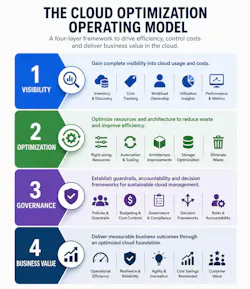
How do you start? Establish infrastructure cost visibility before cutting cloud costs
The first step is visibility.
Before cutting cloud costs, IT teams need to understand what resources are running, why they’re running and who owns them. Cloud environments often grow faster than governance processes, allowing unused storage, oversized virtual machines, idle databases and inefficient architectures to quietly increase spending.
Your cloud cost baseline should include:
- Compute resources and utilization levels.
- Storage consumption and life cycle policies.
- Network traffic and data transfer costs.
- Application dependencies.
- Business owners responsible for workloads.
- Performance requirements and service-level agreements.
Establishing infrastructure cost visibility helps enterprises identify where spending is coming from and where optimization opportunities exist.
So, ask questions such as:
✓ Do we know the cost of each major workload?
✓ Are cloud costs growing faster than business growth?
✓ Are resources assigned to owners or business units?
✓ Which workloads drive the highest spending?
✓ Are we measuring utilization, not just purchased capacity?
✓ Are inactive or low-value resources identified?
✓ Are application teams accountable for infrastructure consumption?
✓ Are costs predictable month to month?
Why it matters: The goal is to connect infrastructure spending to business outcomes. Without visibility, optimization becomes a cost-cutting exercise instead of a strategic discipline. A clear understanding of costs helps you reduce waste while protecting the workloads that create business value.
How to reduce cloud waste: Right-size infrastructure for actual workloads
One of the most common cloud inefficiencies is overprovisioning.
Traditional infrastructure planning often requires buying enough capacity for peak demand, but cloud environments require a different approach: matching resources to actual workload needs.
Infrastructure Optimization Checklist: Connect Infrastructure Spending to Business Outcomes
Without visibility, optimization becomes a cost-cutting exercise rather than an engineering discipline. You risk reducing resources that support critical business operations while overlooking waste that exists elsewhere. Here’s a useful checklist to help you cover the most important areas:
✓ Do we know the cost of each major workload?
✓ Are cloud costs growing faster than business growth?
✓ Are resources tagged to owners or business units?
✓ Which workloads account for the highest spend?
✓ Are we measuring utilization, not just capacity purchased?
✓ Are inactive or low-value resources automatically identified?
✓ Are application teams accountable for infrastructure consumption?
✓ Are costs predictable month to month?
Right-sizing infrastructure might include actions like:
- Adjusting compute instance sizes.
- Moving workloads to more efficient architectures.
- Using autoscaling for changing demand.
- Removing idle environments.
- Optimizing storage tiers.
For example, an enterprise running development environments continuously may be paying for capacity that’s only needed during business hours. Automating shutdown schedules or scaling resources dynamically can reduce unnecessary consumption.
Why it matters: The goal isn’t simply using fewer resources. It’s using the right resources for the business need.
Read our article, “7 Ways Systems Integrators Help with IT Cloud Strategies — and What To Do if They Fall Short.”
Enter FinOps: Build cloud financial management into infrastructure operations
Cloud cost management can’t remain the responsibility of finance teams or a small group of cloud engineers. It requires shared accountability across infrastructure, application development, security and business teams.
This is where FinOps becomes an operating model rather than a reporting function.
A mature approach creates:
- Shared cost ownership between IT and business teams.
- Budget thresholds and alerts.
- Regular workload reviews.
- Cost accountability during architecture decisions.
- Continuous optimization processes.
Why it matters: The objective is to build cost awareness into everyday infrastructure decisions.
What cloud optimization metrics should every IT leader track?
Move beyond total cloud spend and track these metrics:
- Cost per workload.
- Infrastructure utilization rate.
- Cost per transaction or business outcome.
- Percentage of unused resources.
- Forecast accuracy.
- Optimization savings reinvested into innovation.
Decide: Should you optimize, modernize or retire workloads?
Not every workload should be optimized the same way.
When reviewing an application or architecture, decide whether you should optimize, modernize or retire it. Ask these questions:
- To optimize: Can the current architecture run more efficiently through rightsizing, automation or configuration changes?
- To modernize: Would a different architecture — such as containers, managed services or serverless options — improve efficiency?
- To retire: Does this workload still provide enough business value to justify its infrastructure cost?
Why it matters: This decision framework helps enterprises avoid spending time optimizing systems that should be redesigned or removed instead.
How to prepare cloud infrastructure for AI and data growth workloads
As you know, AI has completely changed your job, including its infrastructure economics. After all, training and inference workloads can create significant demand for compute, storage and networking resources.
As your enterprise deploys AI applications, your infrastructure teams need greater visibility into:
- GPU and accelerator utilization.
- Data movement costs.
- Storage growth.
- Model hosting requirements.
- Workload scheduling.
Why it matters. A cloud environment optimized for traditional applications likely isn’t optimized for AI workloads.
The key question becomes: Are we building infrastructure that efficiently supports the business capabilities we are trying to create?
Automate continuous optimization
Cloud optimization isn’t a one-time project, because your infrastructure changes constantly as applications scale, teams deploy new services and business priorities shift.
It’s important to create continuous optimization processes through:
- Automated resource monitoring.
- Infrastructure-as-code governance.
- Policy-based controls.
- Regular architecture reviews.
- Automated cleanup of unused resources.
Why it matters. The goal is to move from reactive cost reduction to proactive infrastructure management.
The most successful CTOs and CIOs are asking, ‘How do we generate more business value from every unit of cloud spend?’
Align metrics with business outcomes in 90 days
A focused roadmap can help your team establish momentum in 90 days.
First 30 days: Establish visibility.
- Inventory cloud resources.
- Identify major cost drivers.
- Assign workload ownership.
- Create baseline infrastructure metrics.
Days 31-60: Improve efficiency.
- Right-size workloads.
- Remove unused resources.
- Review storage and networking costs.
- Establish optimization priorities.
Days 61-90: Build governance.
- Create recurring cost reviews.
- Automate optimization workflows.
- Align infrastructure decisions with business value.
To learn more, read our article, “How IT Leaders Can Create an Effective Data Governance Strategy.”
Which metrics should you track?
Infrastructure metrics alone don’t show business impact. So, instead of only focusing on KPIs like compute utilization, storage consumption and resource counts, track business-value metrics such as:
- Cost per customer.
- Cost per transaction.
- Cost per application.
- Cloud spend as a percentage of revenue.
- ROI of AI initiatives.
Why it matters: The most mature enterprises measure value alongside cost control, not simply cost reduction.
Cloud optimization is now a leadership issue
Cloud optimization has moved beyond infrastructure management to become a strategic operating discipline connected to financial performance, agility and innovation.
As organizations scale AI initiatives, modernize applications and manage hybrid environments, IT leaders need confidence that technology investments deliver measurable value.
Enterprises that succeed will be those that continuously optimize infrastructure to create a scalable foundation for business growth.
About the Author

Theresa Houck
Contributor
Theresa Houck is an award-winning B2B journalist with more than 35 years of experience covering industrial markets, strategy, policy, and economic trends. As Senior Editor at EndeavorB2B, she writes about IT, OT, AI, manufacturing, industrial automation, cybersecurity, energy, data centers, healthcare, and more. In her previous role, she served for 20 years as Executive Editor of The Journal From Rockwell Automation magazine, leading editorial strategy, content development, and multimedia production including videos, webinars, eBooks, newsletters, and the award-winning podcast “Automation Chat.” She also collaborated with teams on social media strategy, sales initiatives, and new product development.
Before joining EndeavorB2B, she was an Industry Analyst at Wolters Kluwer in its human resources book publishing operation. Before that, she spent 14 years with the Fabricators & Manufacturers Association, Intl., serving as Executive Editor of four magazines in the sheet metal forming and fabricating sector, where she managed and executed editorial strategy, budgets, marketing, book publishing, and circulation operations, and negotiated vendor contracts.
Houck holds a Master of Arts in Communications from the University of Illinois Springfield and a Bachelor of Arts in English from Western Illinois University.
 Resources
Quiz
Your Competitive Edge, DeliveredStay ahead of the curve with weekly insights into emerging technologies, cybersecurity, and digital transformation. TechEDGE brings you expert perspectives, real-world applications, and the innovations driving tomorrow’s breakthroughs, so you’re always equipped to lead the next wave of change.