Carbon Emissions are the CTO’s Problem Now: What Should You Do?
Key Highlights
- CTOs are increasingly responsible for understanding the environmental impact of cloud growth, AI workloads, software design, hardware refresh cycles, supplier ecosystems and data centers.
- Companies that lead next decade’s transition will be the ones whose tech leaders continuously measure, manage and optimize carbon.
- Nearly every technology decision now has an energy consequence.
- If CTOs want to reduce carbon meaningfully, they must shift from static reporting to dynamic carbon observability. Carbon data should become part of day-to-day operating intelligence.
- The next generation of CTOs will be judged not only by the systems they modernized, but by resources they optimized and emissions they helped avoid.

For many organizations, carbon reduction is still treated as a reporting exercise. Sustainability teams gather data, finance teams prepare disclosures, and IT provides usage figures. But that model is no longer enough.
Tech leaders now sit at the center of one of the fastest-growing sources of enterprise emissions: digital infrastructure. CTOs are increasingly responsible for understanding the environmental impact of cloud growth, AI workloads, software design, hardware refresh cycles, supplier ecosystems and data centers.
In fact, according to International Energy Agency’s (IEA) report released in April 2026, “Energy and AI – Energy demand from AI,” companies that lead next decade’s transition will be the ones whose tech leaders continuously measure, manage and optimize carbon.
Why carbon impact is on the CTO agenda
Global electricity demand is accelerating, with data centers and AI among the drivers. The IEA’s energy and AI report estimates data center electricity use at about 415 terawatt-hours (TWh) in 2024 and projects it could reach about 945 TWh by 2030.
And in the United States, data center power consumption likely will account for almost half of the growth in electricity demand by 2030, the report notes. Driven by AI use, the U.S. economy is set to consume more electricity in 2030 for processing data than for manufacturing all energy-intensive goods combined, including aluminum, steel, cement and chemicals. Think about that.
This matters because nearly every technology decision now has an energy consequence. For example, excessive data retention can increase storage requirements for years. Legacy systems often run on oversized infrastructure. AI models might require high-density compute environments with significant power demand.
Even procurement decisions, such as buying devices too frequently or selecting suppliers with poor energy practices, can lock in emissions for years.
That means digital transformation without carbon intelligence can simply move waste from paper to power.
Carbon impact starts with better data, not promises
According to the Greenhouse Gas Protocol study, “Corporate Accounting and Reporting Standard,” most companies still estimate emissions annually using spreadsheets and generic emission factors. That is useful for compliance, but inadequate for management.
If CTOs want to reduce carbon meaningfully, they must shift from static reporting to dynamic carbon observability. Carbon data should become part of day-to-day operating intelligence rather than a once-a-year disclosure exercise.
Where is U.S. Electricity Demand Headed?
In the United States, the world’s second-largest electricity consumer after China, demand rebounded in 2024, growing by 2% to reach a new high. According to the International Energy Agency (IEA) report, “Electricity 2025 – Demand,” this followed a 1.8% decline in 2023 due to mild weather and weaker manufacturing activity.
The report projects U.S. electricity demand to grow at an average annual rate of 2% over the 2025-2027 period. This is primarily due to higher consumption from data centers. Other significant contributors include households, electric vehicles and the industrial sector — notably large consumers such as semiconductor manufacturers.
That begins with visibility into infrastructure consumption. Tech leaders need to know how much compute capacity workloads consume, how much storage is growing, where network traffic is concentrated, and whether servers are highly utilized or sitting idle.
Energy sourcing is equally important. The same workload run in different geographies can carry different carbon impacts depending on the local grid mix. Regions powered primarily by renewables may produce dramatically lower emissions than regions dependent on fossil fuels. Timing can also matter, because grid intensity changes throughout the day.
App design also matters. Inefficient software architecture creates hidden emissions through excessive API calls, redundant data movement, overprovisioned services, and bloated compute cycles. In the next decade, code quality will increasingly be linked to environmental efficiency.
According to “Standards and Guidance” from the Science Based Targets initiative (SBTi), a corporate climate action organization, the best IT teams build carbon measurement across five layers, as follows.
1. Infrastructure layer: What’s consuming energy?
Without utilization transparency, waste remains invisible. So, track these factors:
- Cloud compute hours by workload.
- Storage volumes and growth rates.
- Network traffic intensity.
- On-prem server utilization.
- Data center power usage effectiveness (PUE).
- Idle versus productive compute ratios.
In the next decade, code quality will increasingly be linked to environmental efficiency.
2. Energy layer: What powers it?
A workload run in one geography can have materially different carbon intensity than the same workload elsewhere. So, it’s important to measure:
- Regional grid carbon intensity.
- Renewable energy sourcing mix.
- Time-of-day emissions factors.
- Supplier electricity disclosures.
3. Application layer: Which software creates carbon drag?
Because code quality increasingly has climate consequences, engineering leaders should instrument:
- CPU-heavy services.
- Excessive API chatter.
- Redundant data movement.
- Over-retention of data.
- Inefficient model inference pipelines.
4. Device and hardware layer: What is embedded carbon?
Operational emissions matter, but so do embodied emissions from hardware manufacturing and disposal. Factors to track include:
- Laptop refresh cycles.
- Server replacement schedules.
- Device repair rates.
- Circular reuse programs.
- Supplier life cycle disclosures.
5. Supply chain layer: What is hidden in Scope 3?
For many enterprises, Scope 3 emissions can represent the majority of total footprint. But there’s a new KPI stack for tech leadership.’
The SBTi recommends companies with material Scope 3 emissions to set targets that cover a significant share of those emissions, such as:
- SaaS vendors.
- Colocation partners.
- Hardware OEMs.
- Outsourced engineering providers.
- Logistics and fulfillment systems connected to tech operations.
The new KPI stack
Traditional IT scorecards usually focus on metrics such as uptime, release velocity, budget performance, utilization and security. Those remain essential, but it’s important to include carbon indicators too (see table).
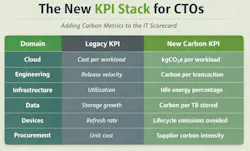
Instead of measuring only cloud spend per workload, CTOs can measure kilograms of CO2e per workload. Instead of looking only at engineering throughput, assess carbon per transaction. Instead of tracking storage growth alone, monitor carbon per terabyte stored. Procurement teams can evaluate suppliers not only by price, but by carbon intensity.
This reframes sustainability from a values discussion into a management discipline. As the “inventor of modern management,” Peter Drucker said, “What gets measured gets managed."
Hardware and Scope 3: The hidden carbon story
Many companies focus only on operational emissions from electricity use, but embodied carbon in hardware manufacturing is another major factor. Every laptop, server, router and device carries emissions from raw materials extraction, production, shipping and disposal.
That means refresh cycles deserve strategic review. Replacing devices too early may increase footprint unnecessarily, while extending device life through repair, refurbishment or redeployment can significantly reduce life cycle emissions.
AI strategy without energy strategy is incomplete strategy.
Beyond internal operations, CTOs should also consider supplier emissions; for many enterprises, Scope 3 emissions represent the largest share of total footprint. This can include cloud vendors, SaaS platforms, colocation providers, outsourced development firms, logistics systems and hardware manufacturers.
So, tech leaders increasingly need supplier transparency on carbon intensity, renewable energy sourcing and life cycle practices.
Three moves high-performing CTOs make first
1. Build a single carbon data model. Leaders integrate data from cloud platforms, ERP systems, procurement tools, facilities teams, Configuration management databases (CMDBs) and supplier disclosures. If finance needs a ledger, carbon strategy needs one too.
You can build a single carbon data model by unifying telemetry from:
- Cloud platforms.
- ERP systems.
- Procurement systems.
- Facilities.
- CMDBs and other asset tools.
- Supplier reports.
2. Put carbon into architecture decisions. Require design reviews to answer these questions:
- Can this workload be serverless or burst-based?
- Does this dataset need hot storage?
- Can inference run in a lower-intensity region?
- Is smaller-model AI sufficient?
- Can we reuse existing platforms?
3. Incentivize engineers with carbon visibility. Engineers improve what they can see. And when carbon becomes visible, it becomes actionable. So, dashboards at team level should show:
- Energy use by service.
- Carbon by deployment.
- Regression after releases.
- Efficiency gains from optimization.
AI is the stress test
Tech leaders can’t ignore AI’s carbon emissions and how to mitigate them. As the IEA “Energy and AI” report noted earlier, accelerated servers linked to AI adoption are a major source of future data-center electricity growth. This means CTOs need governance models that ask:
- What business value justifies model size?
- Can fine-tuning beat retraining?
- What is the carbon ROI of automation?
- Should jobs run batch versus real-time?
- Can lower-latency expectations be relaxed?
AI strategy without energy strategy is incomplete strategy.
Business advantages of measuring carbon
Organizations that master carbon data achieve more than sustainability credibility, including:
- Lower infrastructure costs through efficiency.
- Stronger procurement leverage.
- Better regulatory readiness.
- Faster ESG reporting cycles.
- Reduced operational waste.
- Stronger employer brand.
- More resilient energy planning.
This is why IT carbon measurement is becoming an enterprise intelligence problem, not just a compliance problem.
CTOs becoming Chief Transition Officers
Every major business transition eventually lands in technology: automation, digitization, cybersecurity, AI and now decarbonization.
The next generation of CTOs will be judged not only by the systems they modernized, but by resources they optimized and emissions they helped avoid. Carbon impact with data is not about adding another dashboard. It’s about running a smarter, leaner and more resilient company.
About the Author
 Theresa Houck
 Theresa Houck
Contributor
Theresa Houck is an award-winning B2B journalist with more than 35 years of experience covering industrial markets, strategy, policy, and economic trends. As Senior Editor at EndeavorB2B, she writes about IT, OT, AI, manufacturing, industrial automation, cybersecurity, energy, data centers, healthcare, and more. In her previous role, she served for 20 years as Executive Editor of The Journal From Rockwell Automation magazine, leading editorial strategy, content development, and multimedia production including videos, webinars, eBooks, newsletters, and the award-winning podcast “Automation Chat.” She also collaborated with teams on social media strategy, sales initiatives, and new product development.
Before joining EndeavorB2B, she was an Industry Analyst at Wolters Kluwer in its human resources book publishing operation. Before that, she spent 14 years with the Fabricators & Manufacturers Association, Intl., serving as Executive Editor of four magazines in the sheet metal forming and fabricating sector, where she managed and executed editorial strategy, budgets, marketing, book publishing, and circulation operations, and negotiated vendor contracts.
Houck holds a Master of Arts in Communications from the University of Illinois Springfield and a Bachelor of Arts in English from Western Illinois University.
 Resources
Quiz
Your Competitive Edge, DeliveredStay ahead of the curve with weekly insights into emerging technologies, cybersecurity, and digital transformation. TechEDGE brings you expert perspectives, real-world applications, and the innovations driving tomorrow’s breakthroughs, so you’re always equipped to lead the next wave of change.