NVIDIA Reimagines Artificial Intelligence: What Its Latest Moves Mean to the Future of IT Infrastructure and Strategy
Key Takeaways
- NVIDIA recently unveiled new partnerships and products providing a roadmap for IT professionals to build AI-enabled, high-performance, and secure computing environments.
- NVIDIA CEO Jensen Huang repositioned the company as not just a chipmaker, but as a cornerstone of AI-driven enterprise infrastructure, spanning data centers, networking, quantum computing, cybersecurity, and operational AI.
- NVIDIA became the first company in history to surpass a $5 trillion valuation, signaling investor confidence in its AI-driven growth and expanding role in shaping global IT infrastructure.
- Huang introduced a new computing model leveraging CUDA, parallelism, and accelerated GPU computing, underpinning AI-native enterprise architecture and next-generation supercomputing.
- Huang said its technology increasingly will be embedded in critical infrastructure affecting daily life and shape how enterprises design, deploy, and secure their systems.
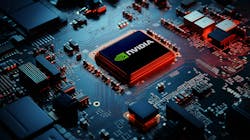
In one of its most ambitious series of announcements to date, NVIDIA recently unveiled more than a dozen groundbreaking partnerships and products that collectively mark a turning point for enterprise technology. CEO Jensen Huang positioned the company not just as a chipmaker, but as a cornerstone of next-generation IT infrastructure and artificial intelligence (AI) expansion — spanning data centers, networking, quantum computing, cybersecurity, and operational AI.
For CIOs, CTOs, CSOs, CISOs, and IT network professionals, these developments carry deep implications: they outline the technical foundation on which AI-native enterprises will be built.
These coincided with a major milestone: On October 29, NVIDIA became the first company in history to surpass a $5 trillion market valuation — a symbolic and strategic turning point for the global technology ecosystem. Its stock rose more than 3% the next day, driven by investor confidence in AI and the company’s expanding global dominance across industries that form the foundation of IT infrastructure, from networking and data centers to quantum computing and cybersecurity.
The historic valuation followed a whirlwind week that included an almost overwhelming number of announcements surrounding the sold-out October NVIDIA GTC AI conference in Washington, D.C.
CEO Jensen Huang discussed some of those announcements during his keynote address, including plans to build AI supercomputers, robotaxis, and the AI platform for 6G; a blueprint for how to build gigascale AI data centers; a new quantum GPU interconnect; and a newly invented computer paradigm.
He also invigorated the technology world by spotlighting the chipmaker’s expanding role in global AI and computing strategy. He outlined his vision for the future and NVIDIA’s role in it, saying he wants NVIDIA to make its technology central to everyday life, including everything from cell phone towers and robotic factories to self-driving cars and healthcare.
He framed the AI era as the next industrial revolution — one that will transform how IT organizations design, deploy, and secure computing environments.
First New Computer Model in 60 Years
As Huang outlined his roadmap for U.S. leadership in AI infrastructure and innovation, ranging from data centers to industrial, commercial, scientific, and government applications, he said one of NVIDIA’s biggest accomplishments is inventing a new computing mode — the first new computing model in 60 years.
It uses NVIDIA’s CUDA platform and leverages parallelism, GPUs, and accelerated computing.
“We invented this computing model because we wanted to solve problems that general-purpose computers could not,” Huang said.
“We observed that if we could add a processor that takes advantage of more and more transistors, apply parallel computing, add that to a sequential processing CPU, we could extend the capabilities of computing well beyond — and that moment has really come.”
Accelerated computing begins with NVIDIA CUDA X libraries across the stack — from cuDNN and TensorRT LLM for deep learning, to RAPIDS (cuDF/cuML) for data science, cuOpt for decision optimization, cuLitho for computational lithograph, CUDA Q and cuQuantum for quantum and hybrid quantum classical computing, and more.
“This really is the treasure of our company,” he declared.
Other Major Announcements with Enterprise IT Impact
Across more than a dozen announcements, Huang unveiled alliances and products that will affect how IT professionals and data-driven organizations architect their next-generation systems. Those revelations include the following:
1. Data Centers and Supercomputing. NVIDIA will build seven AI supercomputers for the U.S. Department of Energy (DOE)—including partnering with Oracle to build the agency’s largest supercomputer for scientific discovery, called the Solstice System, with 100,000 of NVIDIA’s Blackwell chips, advancing scientific and industrial computing capabilities.
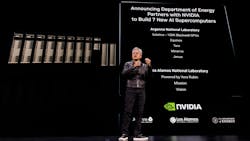
For IT architects, this sets a new standard for federated AI infrastructure—systems that combine massive compute power with efficient scaling and secure workload management. The DOE collaboration effectively prototypes the AI-powered data center of the future, one that private enterprises can model in their own environments.
2. Networking and 6G. A $1 billion partnership with Nokia marks NVIDIA’s entry into AI-driven telecommunications. The companies will codevelop AI-native 6G networking infrastructure, fusing enterprise and edge computing with intelligent connectivity.
For network engineers and CTOs, this means preparing for a new paradigm where AI manages network behavior autonomously, optimizing bandwidth, predicting failures, and enforcing security policies dynamically. This evolution will reshape how enterprise networks are designed, deployed, and secured in hybrid and multi-cloud environments.
3. Operational AI Integration. A collaboration with Palantir Technologies aims to build a unified operational AI stack for complex government and enterprise environments, integrating analytics, automation, and specialized AI agents. For IT operations teams, this stack could redefine observability and automation, transforming reactive monitoring into proactive, AI-guided decision-making that improves uptime, efficiency, and response speed.
4. Cybersecurity. NVIDIA expanded its partnership with CrowdStrike to deliver continuously learning AI cybersecurity agents that learn continuously across the cloud, data center, and edge. Using Charlotte AI AgentWorks, NVIDIA Nemotron open models, NVIDIA NeMo Data Designer synthetic data, NVIDIA Nemo Agent Toolkit, and NVIDIA NIM microservices, these agents aim to detect, adapt, and respond to threats at machine speed.
For CISOs and security teams, this represents a move toward adaptive, AI-driven defense at machine speed. It also signals a self-evolving cybersecurity ecosystems, where threat intelligence and response aren’t separate processes, but continuous, automated functions embedded directly in infrastructure.
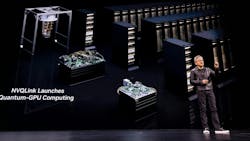
5. Quantum Computing. Huang announced the release of NVQLink, an open system architecture connecting quantum and GPU computing to 17 quantum builders and nine major U.S. supercomputing labs, giving researchers and enterprises a platform for real-time quantum-classical computing to build accelerated quantum supercomputers. Researchers and developers can access NVQLink through its integration with the NVIDIA CUDA-Q software platform.
NVIDIA CEO Jensen Huang announced the release of NVQLink for Quantum Computing
“Just about every single DOE lab [is] working with our ecosystem of quantum computer companies and these quantum controllers so that we can integrate quantum computing into the future of science,” Huang said.
For enterprises investing in high-performance or scientific computing, NVQLink hints at what’s next: quantum-accelerated AI systems capable of solving problems that exceed classical computational limits.
6. AI Factory Blueprint. To support the AI surge, the company launched the “mega” Omniverse DSX Blueprint, an open reference design for gigascale AI data centers, or AI factories, in which Oracle, Microsoft, Google, and other leading tech firms are investing billions. These designs integrate simulation, operations, and digital twins to optimize power use, thermal management, and network architecture. In addition:
- The blueprint expands to include libraries for building factory-scale digital twins, with Siemens’ Digital Twin software first to support the blueprint and FANUC and Foxconn Fii first to connect their robot models.
- Belden, Caterpillar, Foxconn, Lucid Motors, Toyota, Taiwan Semiconductor Manufacturing Co. (TSMC), and Wistron build Omniverse factory digital twins to accelerate AI-driven manufacturing.
- Agility Robotics, Amazon Robotics, Figure, and Skild AI build a collaborative robot workforce using NVIDIA’s three-computer architecture.
For CIOs and infrastructure leaders, these models offer a path toward sustainable, secure, and efficient AI infrastructure that can scale with enterprise needs while minimizing risk.
7. Accelerated Gigascale AI Infrastructure. The chipmaker introduced the NVIDIA BlueField-4 data processing unit (DPU), part of the full-stack BlueField platform that accelerates gigascale AI infrastructure, delivering massive computing performance, supporting 800 gigabytes/second of throughput and enabling high-performance inference processing. At a high level, BlueField-4 offloads and accelerates data-intensive tasks that traditionally bog down CPUs.
8. Digital Twins and Fusion Research. In collaboration with General Atomics and U.S. national labs, NVIDIA is developing a high-fidelity AI digital twin for fusion energy research. This work demonstrates how simulation and AI can merge to accelerate discovery — a model enterprise IT can adapt for predictive maintenance, reliability engineering, and sustainability analytics.
Across every layer of technology—from chips to cloud, from security to quantum—NVIDIA is signaling a future where AI isn’t an application but an architecture.
9. National AI Infrastructure. NVIDIA is working with the U.S. DOE and leading companies to construct a national AI infrastructure. This is a strategic initiative to drive both scientific advancement and economic competitiveness.
For enterprise leaders, aligning with this ecosystem means adopting infrastructure that’s interoperable, secure, and future-ready — a vital move as AI becomes the backbone of both national and enterprise strategy.
What This Means for IT Leaders
For CIOs, CTOs, and infrastructure architects, NVIDIA’s announcements point to an accelerating convergence of compute, connectivity, and intelligence.
- Data Center Strategy. The shift to accelerated computing will demand rethinking workload orchestration, energy efficiency, and GPU-optimized software stacks.
- Networking. AI-native 6G and NVLink architectures suggest a future where low-latency, high-throughput systems are mandatory, not optional.
- Cybersecurity. AI-driven defense models are becoming embedded in infrastructure, requiring integration across existing SIEM, SOAR, and XDR tools.
- Quantum Readiness. The NVQLink model shows that hybrid computing environments — blending classical, GPU, and quantum compute — are approaching practical reality.
- Regulatory Awareness. Export controls, AI governance, and national policy will increasingly shape enterprise IT strategy and vendor selection.
Fluctuating Status of China Exports
President Trump’s comments after meeting with Huang before the NVIDIA GTC conference fueled investor optimism that the chipmaker might be allowed to sell modified versions of its advanced AI chips to China, and this helped NVIDIA attain the $5 billion valuation.
Trump praised the company’s Blackwell processor as “super duper” and said he’d discuss it with Chinese leader Xi Jinping during his trip for the Asia-Pacific Economic Cooperation Summit. However, after Trump’s October 30 meeting with Xi, the president told reporters while semiconductors were discussed and China intended to “talk to NVIDIA and others about taking chips,” the Blackwell processor itself was not part of the conversation.
U.S. restrictions on AI chip exports have sought to prevent Beijing from gaining a technological edge, but a possible easing of those rules — even for a downgraded version of the Blackwell processor — would represent a major strategic shift. For IT and cybersecurity leaders, this evolving policy environment underscores how national security, AI innovation, and global data infrastructure are increasingly intertwined and continuously shifting.
Huang underscored this during his GTC keynote: “We want America to win this AI race — and we want the world to be built on an American tech stack. But we also need to engage globally to win developers.”
While some analysts warn of an AI investment bubble, Huang rejects the comparison to the 1990s dot-com era bubble, pointing instead to tangible value creation. The combination of massive enterprise demand, public-sector investment, and emerging AI-native industries supports his case.
Architecture for the Next Decade
Across every layer of technology — from chips to cloud, from security to quantum — NVIDIA is signaling a future where AI isn’t an application but an architecture.
This will redefine how to design scalable, AI-native systems and offer a model for adaptive, real-time cyber defense. It also helps IT professionals reimagine how systems are built, monitored, and optimized.
And NVIDIA's growth isn’t just a stock market story; it’s a roadmap for the infrastructure of the next decade. And the growth activities of its competitors reflect the same. Whether in data centers, networks, or cybersecurity operations, AI acceleration will be the defining characteristic of competitive IT environments.
Want the EDGE delivered to your inbox every week?
It's free to subscribe, but the intel is priceless.
About the Author
 Theresa Houck
 Theresa Houck
Contributor
Theresa Houck is an award-winning B2B journalist with more than 35 years of experience covering industrial markets, strategy, policy, and economic trends. As Senior Editor at EndeavorB2B, she writes about IT, OT, AI, manufacturing, industrial automation, cybersecurity, energy, data centers, healthcare, and more. In her previous role, she served for 20 years as Executive Editor of The Journal From Rockwell Automation magazine, leading editorial strategy, content development, and multimedia production including videos, webinars, eBooks, newsletters, and the award-winning podcast “Automation Chat.” She also collaborated with teams on social media strategy, sales initiatives, and new product development.
Before joining EndeavorB2B, she was an Industry Analyst at Wolters Kluwer in its human resources book publishing operation. Before that, she spent 14 years with the Fabricators & Manufacturers Association, Intl., serving as Executive Editor of four magazines in the sheet metal forming and fabricating sector, where she managed and executed editorial strategy, budgets, marketing, book publishing, and circulation operations, and negotiated vendor contracts.
Houck holds a Master of Arts in Communications from the University of Illinois Springfield and a Bachelor of Arts in English from Western Illinois University.
 Resources
Quiz
Your Competitive Edge, DeliveredStay ahead of the curve with weekly insights into emerging technologies, cybersecurity, and digital transformation. TechEDGE brings you expert perspectives, real-world applications, and the innovations driving tomorrow’s breakthroughs, so you’re always equipped to lead the next wave of change.