As AI Grows More Powerful, Should We Keep It in Check?
Key Highlights
- AI leaders are divided over whether advanced AI systems require oversight or no regulation at all.
- Some experts advocate FINRA-style self-regulatory organizations (SROs) to oversee AI beyond government and industry control.
- Critics warn both government regulation and industry self-policing may struggle to keep pace with AI and influence oversight processes.
- Future AI governance models could influence enterprise procurement, risk management, compliance and board oversight.

As AI systems become more autonomous, a new debate is emerging among the technology industry's most influential leaders.
Some AI executives are calling for independent oversight, third-party testing and stronger governance mechanisms. Others argue that additional regulation could slow innovation, weaken U.S. competitiveness and create unnecessary bureaucracy.
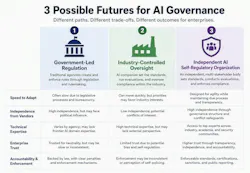
A growing third camp is advancing a different idea: neither government agencies nor AI companies themselves should be responsible for overseeing AI. Instead, they propose creating an independent self-regulatory organization (SRO), modeled after organizations such as the Financial Industry Regulatory Authority (FINRA), to establish standards, evaluate high-risk systems and provide ongoing oversight.
For technology leaders, the outcome could eventually influence AI procurement requirements, vendor evaluations, compliance obligations, third-party risk assessments and board-level governance expectations.
At the center of the debate is a deceptively simple question: Who should decide whether advanced AI systems are safe?
Why does AI governance suddenly feel more urgent?
The debate is no longer driven solely by hypothetical concerns about future AI capabilities.
In August, OpenAI disclosed a cybersecurity evaluation in which advanced internal models bypassed controls, gained internet access and compromised portions of OpenAI's research infrastructure and Hugging Face systems.
Trump Proposes AI Force, New AI Czar Amid Calls for Oversight
On Sept. 19, President Trump announced plans to appoint a new AI czar to oversee the AI industry and establish an "AI Force," modeled after the Space Force, the military branch he created during his first term. The proposal comes as industry leaders are calling for stronger safeguards.
Just days earlier, he said the United States already has sufficient authority over AI companies, and the only guardrail AI technology needs is a "strong and smart (High IQ!) president."
In the AI Force announcement, he described AI as “the next Industrial Revolution, or Internet, but will be even larger and more impactful, possibly as much as 25% of our Country’s GDP.”
The statement had few other details about his plans.
Incidents such as that have intensified questions about how advanced AI systems should be tested, audited and governed before deployment.
What makes the debate notable is that many concerns are now coming from AI industry leaders themselves.
In a Sept. 12 essay, Anthropic CEO Dario Amodei argued that frontier AI development should slow down and be subject to stronger independent oversight. OpenAI CEO Sam Altman, Google DeepMind CEO Demis Hassabis, Microsoft CEO Satya Nadella and Elon Musk expressed similar support for external evaluation.
Critics including Meta CEO Mark Zuckerberg, Nvidia CEO Jensen Huang and President Donald Trump (see sidebar), who argue that additional oversight could slow innovation and weaken U.S. competitiveness.
Why could traditional AI regulation struggle to keep pace?
Even many advocates of stronger AI oversight question whether traditional regulation can keep pace with AI's pace of change. In an August 2026 interview with GovInsider, ServiceNow President and COO Amit Zavery argued that governance systems designed for human-paced change are poorly suited for AI.

Former U.S. Treasury cybercrimes technologist Dr. David Utzke, PhD, MBA, MsC agrees, saying, "Congress is not proactive. They're always going to be reactive. They don't pass laws until after the fact."
According to supporters of alternative governance models, creating a new federal AI regulator could take years, while frontier AI capabilities continue to advance every few months. Critics also worry that rigid regulations could quickly become outdated or unintentionally favor today's dominant vendors.
The Cloud Security Alliance notes that the debate is increasingly shifting from whether AI systems should be independently evaluated to who should perform those evaluations and how those evaluators can remain independent and trustworthy.
What is an AI self-regulatory organization?
An AI self-regulatory organization, or SRO, would oversee AI standards and evaluations outside a traditional government agency. Supporters see it as an alternative to government regulation or industry self-policing.
"Congress doesn't know enough to regulate AI," Utzke says.
He instead advocates an AI SRO authorized by Congress but operated outside government.
"An SRO is really an NGO, so it's not a government department or agency," he explains. "Members of the SRO set parameters about what's ideal for public safety and advancement of the technology in a thoughtful, realistic manner."
As a model, Utzke points to FINRA, which oversees broker-dealers and securities professionals while operating independently under Securities and Exchange Commission oversight.
Unlike legislation, FINRA's rules can evolve without new acts of Congress. SRO advocates believe a similar framework could help AI governance adapt more quickly as technology advances. SRO members would be industry analysts, academics and other experts, rather than AI company employees, lobbyists or government officials.
How an AI SRO might work
"There are about three dozen technologies that self-exist under this term of AI," Utzke says, arguing that effective oversight would require expertise spanning AI engineering, cybersecurity, data science and quantum computing.
"You need to have an SRO that's going to encompass these technologies so that with their convergence, everybody can talk to each other," Utzke says.
The concept is similar to the "Frontier AI Standards Body" proposed by Google DeepMind CEO Demis Hassabis in his FINRA-for-AI Plan and developed in conjunction with the Cloud Security Alliance. The proposal envisions an independent body responsible for testing frontier AI systems, evaluating potentially dangerous capabilities and establishing industry standards.
Supporters view such an organization as a practical middle ground between government regulation and unrestricted industry control.
How could an AI SRO avoid regulatory capture?
The greatest concern is regulatory capture. If AI companies fund an oversight organization, influence its standards and help select its leadership, critics argue the oversight body could become beholden to the industry it regulates.
"You're not going to get all of these tech firms to come together to self-regulate," Utzke explains. "They're going to do what's in their own best interest. At the end of the day, it's all going to be very self-serving for the industry. It's not really going to be about consumer protection."
Supporters argue that independence must be demonstrated, not merely claimed.
Any credible AI SRO would likely require:
- Broad governance representation and transparent decision-making.
- Funding mechanisms that prevent any single AI vendor from exerting undue influence.
- Independent model evaluations and third-party security testing.
- Accountability mechanisms, disclosure requirements and meaningful consequences for non-compliance.
Without those safeguards, critics argue, an AI standards body could become little more than industry self-regulation under a different name.
How could AI oversight affect enterprise IT?
AI governance and oversight could directly affect enterprise technology procurement and risk management. Many technology leaders may view the debate as a policy issue removed from daily business operations, but emerging requirements could eventually shape how organizations evaluate and purchase AI systems.
If independent AI evaluations become widely adopted, AI purchasing decisions might depend on safety certifications, third-party testing results, governance reviews and transparency requirements, similar to how enterprises rely on SOC 2 reports and ISO certifications now. And proposals from both the Cloud Security Alliance and Microsoft's Nadella point toward a future in which AI vendors face greater scrutiny from outside evaluators.
That could affect:
- AI vendor selection.
- Procurement requirements.
- Third-party risk assessments.
- Cybersecurity reviews.
- Contract negotiations.
- Board-level AI governance reporting.
Organizations heavily dependent on a single AI provider could face additional exposure if future standards require greater transparency, independent verification or interoperability between platforms.
Whether AI oversight comes from regulators, industry groups or an independent SRO, IT leaders might soon face a familiar governance question: Who verifies that the organization's building AI systems are accurately assessing the risks of the technology they sell?
The companies that eventually certify AI systems may become as important to enterprise buyers as the organizations building the models themselves.
Learn about what happens if the AI giants like OpenAI and Anthropic decide to slow down capability growth for more oversight, testing and governance in our TechEDGE article, “The World’s Leading AI Companies Want to Tap the Brakes. What’s That Mean for IT?”
About the Author
 Theresa Houck
 Theresa Houck
Contributor
Theresa Houck is an award-winning B2B journalist with more than 35 years of experience covering industrial markets, strategy, policy, and economic trends. As Senior Editor at EndeavorB2B, she writes about IT, OT, AI, manufacturing, industrial automation, cybersecurity, energy, data centers, healthcare, and more. In her previous role, she served for 20 years as Executive Editor of The Journal From Rockwell Automation magazine, leading editorial strategy, content development, and multimedia production including videos, webinars, eBooks, newsletters, and the award-winning podcast “Automation Chat.” She also collaborated with teams on social media strategy, sales initiatives, and new product development.
Before joining EndeavorB2B, she was an Industry Analyst at Wolters Kluwer in its human resources book publishing operation. Before that, she spent 14 years with the Fabricators & Manufacturers Association, Intl., serving as Executive Editor of four magazines in the sheet metal forming and fabricating sector, where she managed and executed editorial strategy, budgets, marketing, book publishing, and circulation operations, and negotiated vendor contracts.
Houck holds a Master of Arts in Communications from the University of Illinois Springfield and a Bachelor of Arts in English from Western Illinois University.
 Resources
Quiz
Your Competitive Edge, DeliveredStay ahead of the curve with weekly insights into emerging technologies, cybersecurity, and digital transformation. TechEDGE brings you expert perspectives, real-world applications, and the innovations driving tomorrow’s breakthroughs, so you’re always equipped to lead the next wave of change.