The Hidden AI Competitive Advantage: Decision-Making Architecture

Moving AI from pilot to production requires more than technology. Most companies have access to the same AI, so the differentiator is execution. Learn how governance, workflow redesign, and decision-making architectures turn experimentation into measurable business results.

Key Highlights

  • Organizations getting the most AI value move beyond pilots and build decision-making architectures that combine AI, workflows, governance and human oversight.
  • Instead of model selection, AI success depends on operationalizing technology through workflow redesign, workforce readiness and disciplined execution.
  • As AI agents scale across the enterprise, governance becomes a critical control layer for managing automated decisions, risk and accountability.
  • The next competitive advantage in AI will come from turning investments into repeatable business outcomes through effective enterprise execution.

The biggest competitive advantage in AI may no longer be the model.

Most enterprises — including at your competitors — now have access to the same foundation models, similar copilots and increasingly similar AI agents. Yet some organizations are generating measurable business value while others remain stuck in experimentation.

The difference isn't better AI. It's better execution.

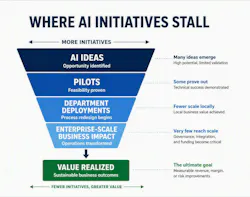
McKinsey & Company’s The State of AI in 2025 report found that nearly two-thirds of organizations remain in experimentation or pilot phases, and only 39% report measurable earnings before interest and taxes (EBIT) impact from AI despite widespread adoption.

The organizations pulling ahead aren't necessarily using better models. They're building decision-making architectures that combine AI, workflows, governance and human oversight into repeatable business capabilities.

Build a decision-making architecture, not a collection of AI projects

One of the biggest leadership mistakes is treating AI as a collection of projects.

Organizations generating the greatest returns increasingly treat AI as an enterprise pipeline that moves ideas from experimentation to governed, repeatable operations. That pipeline typically includes:

  • Opportunity selection.
  • Business case development.
  • Governance review.
  • Workforce readiness.
  • Deployment.
  • Performance measurement.
  • Continuous improvement.

Rather than funding isolated experiments, organizations should strive to build a decision-making architecture that can consistently convert AI investments into business outcomes.

And the urgency is growing. Research firm Gartner Inc. forecasts that 40% of enterprise applications will include task-specific AI agents by the end of 2026, up from less than 5% in 2025. 

Enterprises are increasingly deploying automated decision-making systems at scale. As AI agents become embedded across business operations, tech leaders will need to govern and manage thousands of automated decisions that influence customers, employees, operations and revenue.

McKinsey’s AI study found that organizations achieving the greatest value from AI are redesigning workflows and operating models rather than simply layering AI onto existing processes. 

For example, a chatbot that answers customer questions is a pilot. A system that integrates with customer records, applies policy, routes exceptions, updates downstream systems and measures outcomes is an operating model.

That's why organizations create AI-driven business value by rethinking how work moves through the business, not by automating a single task.

Where does AI create economic value?

Many early AI initiatives focused on efficiency. Productivity still matters, but executive teams are increasingly asking IT leaders harder questions:

  1. Does AI accelerate revenue growth?
  2. Does it improve margins?
  3. Does it reduce risk?

Organizations seeing the strongest returns tie AI initiatives to strategic business outcomes instead of technology metrics.

One of the biggest leadership mistakes is treating AI as a collection of projects.

PwC's 2025 AI Jobs Barometer report found that AI-intensive industries experienced 27% growth in revenue per employee — more than three times the increase observed in less AI-intensive sectors.

The most important shift may be that executives are no longer evaluating AI tools. Leaders are evaluating whether the organization's decision-making architecture produces measurable business results.

Governance should accelerate innovation, reduce risk

Faced with AI risk, many organizations have responded by adding layers of approvals, reviews and oversight. The danger is that governance becomes a bottleneck instead of an accelerator. It’s important to establish guardrails that support speed.

McKinsey's 2026 AI Trust Maturity Survey found that organizations scaling AI successfully are investing in formal governance, risk management and oversight capabilities to support increasingly autonomous AI systems. The research argues that trust and governance have become foundational requirements for realizing value from AI at enterprise scale.

Decision-making architecture is the competitive advantage

Most organizations now have access to the same models.

The next competitive advantage won't come from AI itself. It will come from the decision-making architecture surrounding it: the workflows, governance, oversight and operating disciplines that determine how AI influences the business.

Running more pilots won’t create an advantage on its own. The organizations that pull ahead will be the ones that can turn AI into repeatable, measurable business results.


About the Author

Theresa Houck

Theresa Houck

Contributor

Theresa Houck is an award-winning B2B journalist with more than 35 years of experience covering industrial markets, strategy, policy, and economic trends. As Senior Editor at EndeavorB2B, she writes about IT, OT, AI, manufacturing, industrial automation, cybersecurity, energy, data centers, healthcare, and more. In her previous role, she served for 20 years as Executive Editor of The Journal From Rockwell Automation magazine, leading editorial strategy, content development, and multimedia production including videos, webinars, eBooks, newsletters, and the award-winning podcast “Automation Chat.” She also collaborated with teams on social media strategy, sales initiatives, and new product development.

Before joining EndeavorB2B, she was an Industry Analyst at Wolters Kluwer in its human resources book publishing operation. Before that, she spent 14 years with the Fabricators & Manufacturers Association, Intl., serving as Executive Editor of four magazines in the sheet metal forming and fabricating sector, where she managed and executed editorial strategy, budgets, marketing, book publishing, and circulation operations, and negotiated vendor contracts.

Houck holds a Master of Arts in Communications from the University of Illinois Springfield and a Bachelor of Arts in English from Western Illinois University.

Quiz

mktg-icon Your Competitive Edge, Delivered

Stay ahead of the curve with weekly insights into emerging technologies, cybersecurity, and digital transformation. TechEDGE brings you expert perspectives, real-world applications, and the innovations driving tomorrow’s breakthroughs, so you’re always equipped to lead the next wave of change.
marketing-image