How Can CIOs Scale AI-Enabled Automation Pipelines While Controlling Risk?
Key Highlights
- Automation's greatest threat isn't technical failure; it's governance debt that quietly increases costs, complexity and risk as automation scales.
- Organizations that govern automation as a portfolio, not a collection of projects, are better positioned to sustain ROI and control risk.
- As AI agents gain autonomy, leaders must shift from governing workflows to governing decision-making authority.
- The enterprises that scale automation most successfully will balance speed with visibility, accountability and business-focused governance.

Prefer to Listen?
The first 50 automations usually save money. The next 500 can quietly destroy ROI.
The problem isn't automation. It's governance debt.
As automation scales across the enterprise, unmanaged workflows, fragmented ownership and poorly governed AI systems can create costs, complexity and risk that erode the value automation was supposed to deliver.
For technology leaders, that may become one of the defining challenges of the AI era.
Governance debt threatens automation ROI
Most executive conversations about automation focus on implementation. Increasingly, that's the wrong conversation.
According to IBM's 2025 CEO Study, executives expect AI investment growth to more than double over the next two years, yet half say rapid technology investment has already created disconnected technology environments inside their organizations.
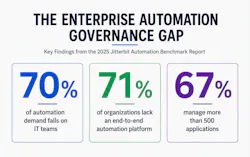
Meanwhile, Jitterbit's 2025 Automation Benchmark Report found that 67% of organizations manage more than 500 applications, while 71% lack an end-to-end automation platform capable of unifying them (see table).
Together, these findings point to a growing challenge: Automation is scaling faster than visibility.
And that's where governance debt begins. Like technical debt, governance debt compounds over time.
The danger is the invisible complexity that accumulates around automation over time.
Automation sprawl increases enterprise risk and cost
IT leaders often evaluate automation projects individually.
For example, a business unit automates customer onboarding. Finance automates invoice processing. HR automates employee provisioning. Security automates incident response. And each project generates value.
Collectively, however, they might create a different set of problems.
Consider a multinational manufacturer that spends several years encouraging business units to automate independently. Procurement automates vendor onboarding. Finance automates invoice approvals. HR automates employee provisioning. Customer service automates case routing.
All that time, every initiative meets its objectives. But then the organization upgrades a core enterprise resource planning (ERP) platform.
Suddenly, nobody can agree which workflows are still being used, which are redundant, and which support business-critical processes that can't be interrupted. Some automations rely on duplicate integrations. Others use different security models to access the same systems. Nobody is entirely sure which workflows are business-critical and which can be retired.
The most effective organizations classify automation according to business risk and apply controls proportionally.
What began as an efficiency initiative has evolved into a management problem. The issue isn't that any one automation failed; it’s that nobody was managing the portfolio.
A similar problem can emerge in highly regulated industries. A healthcare provider automates patient communications, scheduling, billing and claims processing. Individually, every workflow complies with privacy requirements.
Collectively, however, those automations can create data-sharing patterns that only a few people fully understand.
Nobody intentionally creates shadow automation. It emerges one workflow at a time. This illustrates why governance should be viewed as a business discipline rather than a compliance exercise.
Eventually, governance debt shows up as operating expense.
Poor automation governance creates costly cleanup projects
Many enterprises don't discover governance debt until a major transformation initiative begins.
Imagine a company preparing a large-scale cloud migration. Tech leaders expect automation assets to accelerate the transition. Instead, teams discover hundreds of undocumented workflows connected to legacy systems scheduled for retirement.
As a result, the migration slows down. Resources are diverted to identifying dependencies, assigning ownership, rebuilding integrations and documenting workflows that should’ve been cataloged years earlier.
The original automation projects saved money, but the cleanup projects consumed it.
That's why governance should be viewed as an investment in future agility rather than a cost center.
10 Questions CIOs Should Ask Before Approving an Automation Pipeline
Before approving a new automation initiative, ask:
- What business outcome will this improve?
Define the expected value, whether cost reduction, productivity, revenue growth or risk reduction. - Who owns it?
Every automation needs both a business owner and a technical owner. - What data will it access?
Understand whether sensitive, regulated or proprietary information is involved. - What happens if it fails?
Identify operational impacts and fallback procedures before deployment. - Does it create new security risks?
Review permissions, access controls and monitoring requirements. - Can it be audited?
Ensure decisions, actions, and data usage can be traced and reviewed. - Does something similar already exist?
Avoid creating duplicate workflows that increase complexity and costs. - What level of governance does it require?
Apply oversight based on business risk, not a one-size-fits-all approach. - If AI is involved, what decisions can it make independently?
Define where human review remains mandatory. - How will success be measured?
Establish ROI, productivity, customer experience or risk-reduction metrics before launch.
If you can't clearly answer all 10 questions before deployment, you're likely creating governance debt before the automation even goes live.
Four layers of an effective automation governance framework
Many enterprises treat governance as a collection of controls, but it should be treated as an operating model with four layers. Let’s look at those.
Layer 1: Visibility. Many enterprises track every server, application and cloud workload they own. Yet surprisingly few can produce a complete inventory of their automations.
As a tech leader, ask yourself these questions:
- Do I know how many automations are currently operating across the enterprise?
- Can I identify an accountable owner for each one?
- Could my team explain which data sources and AI models those automations rely on?
If those answers aren't readily available, governance risk already exists.
Layer 2: Accountability. Every automation needs an owner — a person. Not a department. Not a committee.
Imagine an AI agent authorized to approve low-risk customer exceptions. Over time, it begins approving increasingly complex cases because the data used to determine risk classifications isn't being maintained properly.
Eventually, a business-critical process fails. Nobody can explain how the automation worked, who approved it, or which systems it affected.
The technology wasn't the problem. The absence of ownership was.
Layer 3: Control. Not every automation deserves identical oversight.
A report-distribution workflow shouldn’t receive the same level of scrutiny as an AI-powered customer decision system or an automated cybersecurity response platform.
The most effective organizations classify automation by business risk, allowing low-risk innovation to move quickly while applying stronger oversight where consequences are greater.
Layer 4: Optimization. Visibility, ownership and controls matter. But executives ultimately care about business value. So, every automation portfolio should be measured against:
- Cost reduction.
- Revenue enablement.
- Productivity gains.
- Risk reduction.
- Customer experience improvements.
- Time-to-market acceleration.
An example is a customer onboarding process that spans CRM, identity management, credit review, compliance checks and billing systems. If onboarding volumes suddenly decline, executives need to understand whether the problem originated in a workflow change, an integration failure, an AI classification error or a business rule modification.
Without end-to-end visibility, troubleshooting becomes guesswork.
Governance should help maximize value, not merely prevent mistakes.
Excessive governance can be almost as harmful as insufficient governance.
AI agents require governance of decision-making authority
The real governance challenge is AI systems that increasingly make recommendations, trigger actions and operate with limited human involvement.
A retailer may initially deploy AI agents to summarize supplier communications. Over time, those agents begin recommending order changes, approving routine exceptions and triggering downstream workflows. The organization has quietly shifted from workflow automation to delegated decision-making.
Before deploying AI agents at scale, ask a critical question: What decisions are you willing to let software make without human review?
Risk-based governance prevents automation bottlenecks
Let’s look at the other side of this discussion.
Ironically, some IT leaders create governance risk by trying too hard to eliminate it. Long review cycles and excessive approval requirements often drive employees toward unsanctioned automation tools, creating the very visibility problems leaders hoped to avoid as well as security risks.
Excessive governance can be almost as harmful as insufficient governance.
The goal isn't control for its own sake, but safe acceleration. The most effective governance models reduce friction for low-risk activities while focusing oversight where business consequences are greatest.
Enterprise-wide governance helps automation scale safely
Five years ago, tech leaders worried about shadow IT. Now, they should be worried about shadow automation.
It’s crucial to know who owns and is accountable for the hundreds of automations deployed, how they're governed, and what risks they're creating as they scale.
The enterprises that gain the greatest advantage from automation won't be the ones that deploy the most automations. They'll be the ones that avoid accumulating governance debt.
The companies that struggle most with automation aren't necessarily the ones moving fastest. They're often the ones scaling automation without a clear operating model for ownership, accountability and business value.
About the Author
 Theresa Houck
 Theresa Houck
Contributor
Theresa Houck is an award-winning B2B journalist with more than 35 years of experience covering industrial markets, strategy, policy, and economic trends. As Senior Editor at EndeavorB2B, she writes about IT, OT, AI, manufacturing, industrial automation, cybersecurity, energy, data centers, healthcare, and more. In her previous role, she served for 20 years as Executive Editor of The Journal From Rockwell Automation magazine, leading editorial strategy, content development, and multimedia production including videos, webinars, eBooks, newsletters, and the award-winning podcast “Automation Chat.” She also collaborated with teams on social media strategy, sales initiatives, and new product development.
Before joining EndeavorB2B, she was an Industry Analyst at Wolters Kluwer in its human resources book publishing operation. Before that, she spent 14 years with the Fabricators & Manufacturers Association, Intl., serving as Executive Editor of four magazines in the sheet metal forming and fabricating sector, where she managed and executed editorial strategy, budgets, marketing, book publishing, and circulation operations, and negotiated vendor contracts.
Houck holds a Master of Arts in Communications from the University of Illinois Springfield and a Bachelor of Arts in English from Western Illinois University.
 Resources
Quiz
Your Competitive Edge, DeliveredStay ahead of the curve with weekly insights into emerging technologies, cybersecurity, and digital transformation. TechEDGE brings you expert perspectives, real-world applications, and the innovations driving tomorrow’s breakthroughs, so you’re always equipped to lead the next wave of change.