How To Implement AIOps at Enterprise Scale
Key Highlights
- AIOps employs ML and operational data to automate anomaly detection, event correlation and root cause analysis, reducing noise and alert fatigue.
- Recent trends include integrating large language models for incident summaries, autonomous remediation and unified observability platforms to streamline operations.
- Successful AIOps deployment requires establishing performance baselines, reducing alert noise, validating AI insights and gradually automating remediation tasks.
- Preparation steps involve organizing operational knowledge, updating automation playbooks and building trust through staged automation and validation.
- The future of AIOps includes moving from monitoring to predictive operations, enabling proactive capacity planning and prescriptive remediations.

Monitoring enterprise IT systems has reached unprecedented levels of complexity. Growing volumes of telemetry data and a lack of context have overwhelmed traditional monitoring tools, while IT teams are managing more devices with fewer skilled professionals.
AIOps can help by using AI and machine learning to reduce alert noise and improve root cause analysis. But deploying AIOps at enterprise scale requires more than choosing the right platform.
Recent analysis found that while more than half of AIOps prototypes reached production, the rest failed because of infrastructure rather than the technology itself. A key preliminary step is ensuring that a platform’s strengths align with an organization’s structural and system dependencies. Organizations also need accurate operational data supported by a clear governance framework.
IT teams must be prepared for long-term ML maintenance because models drift and require retraining. A step-by-step maturity approach can help organizations expand automation gradually as confidence grows.
Let's look at recent trends that have transformed AIOps, the features operations teams depend on and key steps to implementation.
AIOps is not a substitute for talent. If teams become overly reliant on AI-driven operations, they risk losing the expertise needed to challenge recommendations and troubleshoot complex incidents.
How AIOps is changing enterprise IT operations
At its most fundamental level, AIOps employs machine learning (ML) and operational data to correlate events across siloed IT systems for anomaly detection and root cause analysis (RCA). First introduced in 2016, the technology has moved from essentially correlating system warnings to employing autonomous, agentic-led task completion. In 2025, Gartner renamed the methodology, Event Intelligence Solutions (EIS), to more accurately describe its two primary functions: alert correlation and knowledge retrieval.
EIS goes well beyond traditional, reactive IT operations where individuals manually set the decision boundaries for taking actions. Recent EIS breakthroughs have centered on deploying statistical LLMs and small language models to analyze logs and metrics, automate RCA and administer self-healing as needed.
“The problem today is not a lack of data. It is having too much of it,” says Sujan Sarkar, co-founder of digital marketing agency OneLittleWeb. “One issue can trigger alerts across five different systems, and humans are left figuring out which ones actually belong together. AIOps is useful mainly because it reduces that noise and helps teams focus on the underlying incident rather than every individual alert,” he adds.
Three trends have helped reshape the AIOps landscape in important ways. First, LLM integrations within AIOps platforms now provide natural language incident summaries, runbook recommendations and verbal contextual analyses to operations teams. Next, organizations are shifting to agentic remediation tasks that take place within predefined guardrails. Organizations start by implementing staged remediations on small tasks to establish trust levels, expanding the scope over time by introducing more complex incidents.
 Id 270046846 | Art © Brick Bones | Dreamstime
 Data center PC screens displays monitoring backend infrastructure performance used in AI model development and automation workloads.
Finally, increasing numbers of observability-plus-operations platforms have become available, helping to unify multiple on-prem tools (e.g., APM management, logs, infrastructure, ITSM, etc.). These platform approaches reduce the integration overhead that connecting these tools previously required and which made AIOps implementations both complex and costly.
The motivations for AIOps adoption are numerous, but certain compelling arguments take precedence. They include the rampant growth of telemetry data in the form of logs, metrics and traces. In addition to false alarms and the sheer number of systems that require consistent monitoring, alert fatigue has measurable negative impacts. Engineers simply burn out chasing false positives and differentiating noise from critical signals that need to be addressed. And regarding skilled professionals for AI-driven IT operations, research shows that 57% of organizations lack professionals proficient in these capabilities.
As a result, structured upskilling and corporate training have become strategic imperatives. As Aishwarya Singh, global head of Microsoft Practice - Cloud & Agentic AI at NTT Data, points out:
"AIOps is not a substitute for talent. … If teams become overly reliant on AI-driven operations, they risk losing the expertise needed to challenge recommendations and troubleshoot complex incidents. The objective should be to automate routine work while preserving critical engineering knowledge and judgment. Eventually, the organizations that succeed will combine AIOps with workforce transformation and upskilling."
The core capabilities of an enterprise AIOps platform
As organizations consider how best to support remediations across domains, they’re investing in AIOps capabilities to proactively detect anomalies, correlate events and automatically perform RCA where needed. Indeed, operational flexibility and customization remain key goals. Towards that end, open source deployments avoid the constraints related to vendor lock-in and the limitations of a single vendor stack. In light of recent ML advances, AIOps provides capabilities to:
1. Detect anomalies: ML-based fault detection uses signals from baseline system behavior reflected in metrics, logs and traces and then identifies any deviations from the norm. A key benefit of AI integration is that it detects anomalies earlier than static threshold-monitoring tools can report.
2. Correlate events: Knowledge of dependencies is crucial for tracing failures across IT systems, and it’s based on accurate topology and service mapping. For example, in terms of storage bottlenecks, which can cause cascading failures, AIOps employs topology-based correlations to trace dependencies, pinpointing exactly where an issue occurred. It then uses that accrued data over time to improve overall correlation success and improve future context propagation.
3. Perform root cause analysis (RCA): Using AIOps for root-cause identification of system failures can indicate the nature of a malfunction and its source. It automatically connects an anomaly to its primary trigger within seconds and then recommends the best action to mitigate the problem.
4. Automate remediations: LLMs have expanded the possibilities for autonomous remediation by proposing commands, fixes and scripts to resolve issues. IT teams can then set boundaries and define which scenarios require human judgment. In software development, code-level remediations often consist of processing entire codebases and surfacing dependencies for RCA, connecting key infrastructure signals to specific code paths responsible for those signals.
Preparing IT infrastructure for AIOps deployment
Challenges to monitoring IT services fundamentally change when applications and IT infrastructure include LLM calls. Before adoption, certain steps are critical for preparing systems for AIOps integration. Operational knowledge should be organized, structured and readily available, from runbooks to naming conventions. Be prepared as well to validate and update automation playbooks, adjusting baselines as services expand and building trust over time when training AIOps to perform self-healing. Increased confidence in model performance and accuracy should drive automation as opposed to moving directly from manual processes to closed-loop automation.
Stage 1: Establish an AIOps performance baseline
Mean time to resolution (MTTR) in IT operations includes the entire repair process from incident detection to recovery of a system. Baselining an entire IT infrastructure offers a snapshot in time of operating standards. IT teams can then use these standards, along with automated monitoring and alerting tools, to address future service incidents. However, static baselines quickly become outdated, particularly in dynamic cloud environments, so attention should be paid to maintaining snapshot accuracy.
Stage 2: Reduce alert noise and build trust
Noise reduction is an important early requirement in AIOps adoption. Achieving fewer, improved alerts will demonstrate to IT teams that the platform can directly reduce alert fatigue, building trust in automated AI insights.
Stage 3: Improve AIOps root cause analysis
Training LLMs in root cause analysis (RCA) involves engineers validating and correcting AI-assisted RCA when necessary. It functions to improve diagnostic accuracy by aligning AI-generated incident explanations with actual operational logic and expert verifications performed by individuals.
Stage 4: Build trust before automating remediation
Employ low-stakes failure patterns to begin automating AIOps remediation capabilities. These consist of restarts, cache flushes, connection pool resets and related function resets. Thorough audit trails will help to confirm validations as these processes are steadily automated.
Stage 5: Move from AIOps monitoring to predictive operations
Predictive operations within AIOps are based on a thoroughly stable foundation. Once that’s established, IT teams are more prepared to move to related actions, such as capacity planning, proactive prevention and detailed, prescriptive remediations.
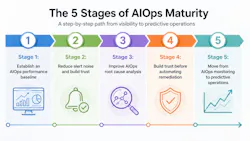
These stages are crucial because they prepare production platforms, systems and IT teams to undertake the four capabilities that define AIOps: detect anomalies, correlate events, analyze causes and support remediation across domains.
“AIOps can already do a good job of correlating incidents, summarizing problems, identifying likely causes and recommending next steps,” states Sukar. “Where I think we are still early is letting AI independently make major production changes. Companies are comfortable automating predictable, low-risk actions, but there is still a big trust gap when it comes to handing an AI agent broad control over critical infrastructure,” he adds.
About the Author
 Kerry Doyle
Kerry Doyle
Contributor
Kerry Doyle focuses primarily on issues relevant to both C-suite and enterprise leaders through technology articles, white papers and analyses. He covers a diverse range of topics, from nanotech to the cloud, open source to AI. Passionate about both the written word and communicating the value of technology, his experience stems from senior editorial positions at PCWeek, PCComputing, ZDNet, and CNet.com. He's a graduate of Boston University with a bachelor's degree in comparative literature.
 Resources
Quiz
Your Competitive Edge, DeliveredStay ahead of the curve with weekly insights into emerging technologies, cybersecurity, and digital transformation. TechEDGE brings you expert perspectives, real-world applications, and the innovations driving tomorrow’s breakthroughs, so you’re always equipped to lead the next wave of change.