Industrial Data Fabrics: The Key to Unlocking AI-Driven Operational Excellence
Key Highlights
- Industrial data fabrics unify siloed IT, OT and ET data, enabling comprehensive insights and operational optimization.
- Pacesetters treat AI as a scalable product, establishing standardized data layers and assembling best-of-breed components for agility and growth.
- Empowered Synapse Workers, supported by Agentic AI, dramatically reduce analysis time and improve asset performance in manufacturing environments.
- Moving AI inference to the edge creates financial advantages by reducing cloud costs and enabling real-time autonomy.
- A strong data foundation and cultural alignment are essential before deploying autonomous AI agents in industrial settings.

Data fabrics are foundational to AI effectiveness in all corners of the economy, but perhaps no more so than the industrial space. In fact, ARC Advisory Group’s core thesis on Industrial AI is that success is built on an industrial-grade data fabric (IDF) that unifies information technology (IT), operational technology (OT) and engineering technology (ET) data.
It is impossible to optimize process, discrete, or hybrid manufacturing processes when the necessary data is isolated in silos across the enterprise, but this perennial problem appears to have finally met its match in AI.
Leaders in Industrial AI have their CIOs, COOs and business development managers collaboratively solving the context problem by aggressively liberating structured and unstructured data and assembling it in a centralized industrial data fabric. Other organizations waiting for the technology to mature or stuck in “pilot purgatory” are rapidly falling behind.
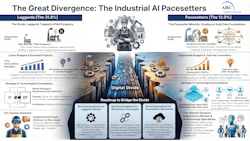
Industrial AI Research Director Colin Masson from ARC Advisory Group graciously agreed to answer some questions about this phenomenon and its impact on the workforce. Also included are key findings from the ARC Industrial AI Pacesetter Report 2026, such as why and how the Pacesetters, representing just 12.9% of the market, are going all in on Industrial AI and what it means for the Mainstream (55.3%) and Laggards (31.8%).
Why is being a “connected worker” insufficient amid the Industrial AI revolution?
Industrial plants are drowning in data yet starved for insight. Simply connecting a worker to digital systems is no longer enough for two main reasons:
- The Human Bottleneck: The industrial sector is suffering from a shortage of qualified personnel to manage these complex systems. In fact, 42% of respondents in our recent survey cited a shortage of AI talent as a primary challenge.
- The Data Silo Debacle: Merely connecting a worker to stubbornly disconnected IT, OT and ET data leaves them with a fractured view of operations. This forces teams to make critical decisions with incomplete information. An industrial data fabric is the architectural solution to the data silo problem.
We must move toward the Symbiotic Factory model that relies on empowering Synapse Workers, or humans who serve as the cognitive “synapses” of the operation. In this environment, AI agents handle automated sequences and programmatic decision automation, while the Synapse Worker retains the critical functions of strategic oversight, exception management and governance.
For instance, Industrial AI Pacesetter Jabil, an industrial electronics and equipment manufacturer, is building tools that allow its synapse workers to orchestrate AI agents, curate context and seamlessly manage complex exceptions.
What are IDF Pacesetters doing differently, and what makes their approach superior?
Our research shows a definitive gap between the market leaders and the rest of the pack:
- The Pacesetter Moat: Pacesetters have built unassailable moats around three pillars: Structural (industrial data fabrics), Cultural (context engineering) and Financial (Edge AI economics). They succeed because they embed AI as a business strategy driven by operational context experts to improve yield, safety or sustainability. Laggards fail because they treat AI primarily as an IT strategy.
- The Innovation Paradox: Pacesetters treat AI as a scalable product by establishing a standardized data layer first, enabling them to "copy and paste" successful AI solutions across their global footprint. Conversely, Laggards treat AI as a bespoke project, but these isolated projects deliver insufficient economic value and fail to scale. We advise Laggards to halt these fragmented, custom initiatives and redirect their focus to plant-level connectivity to establish operational credibility.
- The "Assembled" Approach: Pacesetters realize that you cannot buy a single, monolithic industrial data fabric from one vendor that satisfies the divergent needs of all stakeholders. Instead, leading organizations are assembling their fabrics, weaving together best-of-breed components.
- Data Decoupling: Leaders mandate data decoupling — treating data as a permanent asset and applications as ephemeral tools. They build AI on top of the IDF rather than on legacy applications.
- Financial Advantage: Pacesetters create a financial moat by moving AI inference to the edge. This insulates them from unsustainable cloud consumption costs and enables the low latency needed for real-time autonomy.
Another factor contributing to PepsiCo’s Pacesetter status is its cultivation of a massive internal army of data scientists, ML engineers and professionals who can bridge the gap between data science and physical supply chain physics. The global food and beverage company’s cohesive Industrial AI strategy includes a unified data fabric, Agentic AI, immersive physical simulation with Digital Twins and a workforce empowered to orchestrate it all.
How does this structural advantage lay the foundation for operational excellence and multi-pillar ROI?
An industrial data fabric acts as a reusable "on-ramp" for AI, providing a clean, contextualized and continuous flow of data. This unified foundation unlocks three distinct pillars of ROI:
- Driving Operational Efficiency: By correlating data from disparate sources, predictive maintenance becomes a scalable reality. ARC research has seen companies reduce unplanned downtime by over 30% and cut overall maintenance costs by 10-20%.
- Enhancing Product Quality: A data fabric allows a quality engineer to query the entire production history across enterprise resource planning (ERP) and historian data, turning a multi-week investigation into a focused analysis completed in minutes.
- Strategic Innovation: By providing self-service access to trusted data, it democratizes continuous improvement and fosters a data-driven culture.
Establishing an industrial data fabric as your single source of truth with high-quality, contextualized data is not an IT expense; it is a strategic investment in operational excellence.
Can you describe the example benefits of having empowered Synapse Workers in manufacturing automation and/or asset performance management (APM) roles?
The real-world benefits of pairing Synapse Workers with Agentic AI are staggering. At the recent Cognite IMPACT 2025 event, we saw incredible validation of this approach:
- Aker BP: Achieved a staggering 97% reduction in time for root cause analysis, taking the process from weeks down to hours. They are making ambitious plans to build "hundreds of Atlas AI colleagues" to function as 24/7 teammates.
- NOVA Chemicals: Reported that a complex root cause analysis task, which previously consumed two weeks, can now be completed in a single day using the platform.
- Celanese: Successfully scaled data across 49 plants into their platform and is leveraging agents for high-value activities such as troubleshooting.
What other thoughts do you have for those working to establish a sound Industrial AI data foundation?
The industry has decisively moved past the experimental generative AI hype and into the era of agentic AI. Our Q4 2025 survey indicates that industrial operators prefer autonomy over simple assistance, meaning systems that act, not just chat.
But before piloting autonomous agents, companies must ensure their data foundation and cultural readiness are properly aligned to safely close the loop between the digital and physical worlds. We highly recommend utilizing ARC’s Industrial AI Readiness Assessment tool to establish a baseline.
Get the EDGE delivered to your inbox every Wednesday.
About the Author

Sheila Kennedy
Contributor
Sheila Kennedy, MBA, CMRP, is a professional freelance writer and award-winning journalist specializing in industrial and technical topics. After working for 11 years in industrial information systems, she established Additive Communications in 2003 to leverage that knowledge and her affinity for research and writing.
Sheila has since produced thousands of client deliverables and hundreds of bylined articles, including more than 30 cover stories for industrial trade publications such as Plant Services, where she has been a contributing editor since 2004.
 Resources
Quiz
Your Competitive Edge, DeliveredStay ahead of the curve with weekly insights into emerging technologies, cybersecurity, and digital transformation. TechEDGE brings you expert perspectives, real-world applications, and the innovations driving tomorrow’s breakthroughs, so you’re always equipped to lead the next wave of change.