Capgemini's Five Tech Trends for 2026

2026 is the “year of truth” for AI, driving an AI-rebuilt software life cycle, a hybrid multi-cloud fabric, intelligent operations, and a new push for resilient tech sovereignty.
Dec. 28, 2025
5 min read

Key Highlights

  • 2026 is the “year of truth” for AI: The conversation shifts from hype and pilots to measurable value — and to embedding AI across the enterprise (including human/AI “chemistry” at scale).
  • Agentic AI goes mainstream: Expect dozens to thousands of autonomous agents collaborating to solve problems, making AI ethics less philosophical and more of an engineering discipline.
  • AI reshapes the entire software life cycle: Capgemini predicts a rapid rebuild of legacy systems into adaptive, context-aware software requiring governance and cross-business oversight, not just IT change.
  • Cloud 3.0 + intelligent ops + sovereignty: AI becomes the core cloud workload powering end-to-end “intelligent operations,” while tech sovereignty emerges as a strategic priority built on resilient interdependence rather than isolation.

Capgemini recently revealed its top five tech trends for 2026 in a webcast, predicting that AI will become the “backbone of enterprise architecture, reshape software life cycle development, and redefine cloud consumption,” according to Chief Innovation Officer Pascal Brier.

Brier kicked off the webcast with a look back at Capgemini’s top trends from the previous year (you can review those here) before focusing on 2026, noting that these five trends are not simply “trends” — they will have lasting effects on how companies operate:

1. The year of truth for AI

Mark Roberts, CTO Applied Sciences at Capgemini Engineering and Deputy Director of Capgemini AI, said that while AI continues to attract headlines — and investments — the mood is changing. People have moved beyond the hype and “innovation theater” and are now having mature conversations about delivering tangible uses for AI and fully weaving AI into their organizations. Companies must figure out how to make AI work in the short term while also laying the foundation for the human/AI chemistry that will emerge as we continue to embed AI in more ways.

The emphasis on the integration of AI, rather than the innovation of AI, reflects a technical evolution underway over the past few years that has shifted toward hybrid AI models that blend large generative models with other models — mathematical, simulation, engineering, etc. 

Additionally, while AI ethics used to be discussed in a more philosophical or academic context, it is increasingly becoming an engineering topic as we try to figure out how to make AI models do the right thing without human oversight. This is especially important as autonomous agents are making decisions beyond solving simple problems and automating them. In 2026, expect to see dozens, hundreds, and even thousands of agents working collaboratively to solve problems, unlocking exponential value in agentic AI.

2. AI is eating software

Sudhir Pai, EVP and Chief Technology and Innovation Officer, Financial Services, at Capgemini, said that while the fundamentals of how software is built have not changed, we will see a massive shift in how it is built in 2026 and beyond — not just in coding, but across the entire life cycle. Pai says we will rebuild many software systems powered by AI over the next two to three years — systems that took a couple of decades to build — with a new focus on building adaptive software that can understand context and function as a self-learning system.

This rebuild doesn’t just affect every organization’s IT department; Pai says the rebuild must be holistic, and that AI governance and oversight are critical. Every line of business must rethink how the company will operate in the AI world. 

The upcoming year will see AI become the backbone of enterprise architecture, reshape software lifecycle development, and redefine cloud consumption. At the same time, enterprise systems are undergoing a fundamental shift toward intelligent operations, while tech sovereignty emerges as a strategic priority, driving organizations to build resilient interdependence.

- Pascal Brier, Chief Innovation Officer at Capgemini

3. Cloud 3.0: All flavors of cloud

While cloud technology has been around for 15 years, there is a renewed momentum around the cloud, according to Georgia Smith, Capgemini UK’s Cloud Transformation Leader. As AI becomes the core workload, the cloud serves as both the execution layer and the environment for training models and running autonomous agents. There is not “one” cloud, but all types of clouds working together as one intelligent fabric.

This hybrid, multi-cloud environment is the natural progression of operationalizing AI, where agentic systems run cloud platforms. In this environment, organizations need to upskill constantly. If you’re only asking who the hyperscaler is that can meet your needs, you should also be asking if you have the team and the capability to run agentic systems.

4. The rise of intelligent ops

Simone Neser, AI Taskforce Program Manager at Capgemini Business Services, said that the rise of intelligent operations — hyper automated processes that combine data and AI to make processes more efficient and adaptive — signals a major transformation in how companies will harness the power of AI agents. 

The fundamental daily activities that keep a business running are a great use case for AI in any organization. To build intelligent ops, you must decompose the process and understand each component before you can orchestrate multiple technologies, data sets, and types of work together. This is a complex process that requires a high level of understanding to transform legacy processes. In 2026, the expectation is to move far beyond the pilots of previous years toward a self-improving, agile system.

In 2026, organizations can’t get away with simply optimizing individual processes — intelligent ops requires optimizing end-to-end processes with integrated value chains that enable the management of both internal workflows and external partners. Humans and AI must work together, and this relationship will become more formalized and strategic, with AI focusing on high-volume, repetitive work, freeing humans to focus on higher-value work. For example, AI could handle invoice payments, allowing a human to manage tasks that require nuance, such as negotiating a contract or resolving a dispute.

5. The borderless paradox of tech sovereignty

Guillaume Renaud, Head of Cloud Transformation at Capgemini Invent France, said that the renewed sovereignty momentum is not an IT-only topic, considering the current state of geopolitical tensions and the fragile supply chain for chips, cloud, and AI infrastructure. Additionally, there is increasing scrutiny of where and how data is stored — especially given the risk of large-scale outages.

The “paradox” is that this tech sovereignty exists through interdependence. Renaud stated that total technological autonomy is an illusion, since chips, cloud, software, and AI rely on global supply chains, and that sovereignty is not about isolation but about strategic autonomy that is globally connected yet resilient, controllable, and shock-resistant. 

About the Author

Abby White

Abby White

Vice President, Content Studio

Abby White is a content strategist, newsroom-trained writer, and brand storyteller. As Vice President of EndeavorB2B’s Content Studio, she leads client-driven custom content programs across 90+ brands and the content strategy for topic and role-based newsletters serving executive audiences. An award-winning journalist with a marketer’s mindset, Abby brings 25 years of experience leading editorial, communications, marketing, and audience-building efforts across industries.

Abby launched her first magazine, Abby’s Top 40, in 1988 and made everyone in her family read it. While attending the University of Illinois, she paid her rent as a professional notetaker, which might explain why she still gets asked to take notes in meetings. Since then, she has held editorial leadership roles at an alt weekly, a newspaper, a luxury lifestyle magazine, a business journal, a music magazine, and regional women’s magazines, developing a sharp writing edge and a conversational tone that resonates with professional audiences. 

She expanded into marketing while leading communications for an entertainment industry nonprofit and later drove rebranding and audience-building efforts for an NPR music station. At EndeavorB2B, she has been instrumental in driving editorial excellence, developing scalable content strategies across multiple verticals, and building the foundation for EDGE, the company’s portfolio of executive newsletters. 

And if you’re a writer interested in contributing to TechEDGE, she’s the person you need to (politely) bug.

Quiz

mktg-icon Your Competitive Edge, Delivered

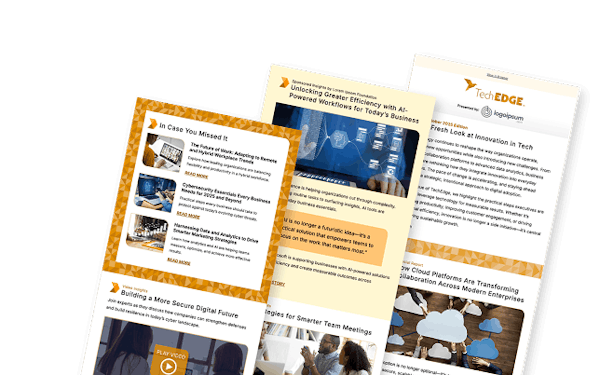
Stay ahead of the curve with weekly insights into emerging technologies, cybersecurity, and digital transformation. TechEDGE brings you expert perspectives, real-world applications, and the innovations driving tomorrow’s breakthroughs, so you’re always equipped to lead the next wave of change.

marketing-image